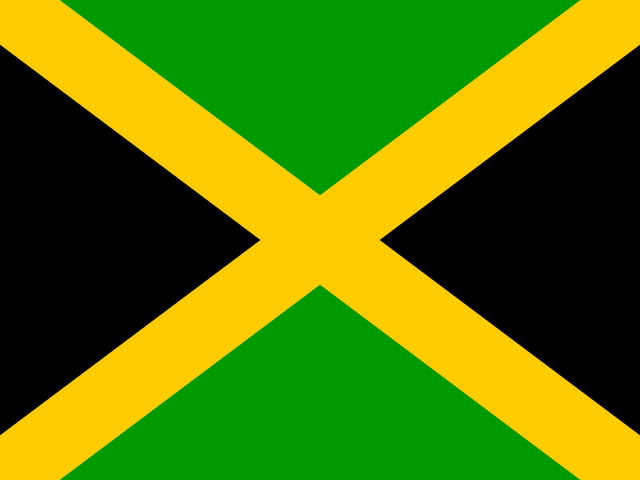
Jamaica
Jamaica · Americas · updated 15.09.2026
Jamaica is the most populous English-speaking island in the Caribbean, with an economy built on tourism (Montego Bay and Negril are the main resort destinations), the bauxite industry, and diaspora remittances. A work permit for foreigners is required under the Foreign Nationals and Commonwealth Citizens (Employment) Act and is issued by the Ministry of Labour and Social Security; CARICOM nationals holding a CARICOM Skills Certificate work without a permit under the CSME free movement of skilled persons regime. Permanent residence through employment is available after more than 3 years of work in the country; naturalisation requires 5 years of cumulative residence, and citizenship by marriage to a Jamaican citizen can be applied for immediately after the marriage is registered. Dual citizenship is permitted without restriction to a list of countries. Importing dogs and cats is mandatory through the sole legal port of entry (Kingston), with 14-day quarantine and a mandatory rabies antibody test (FAVN) regardless of country of origin — no exemption for 'rabies-free countries' was found. The homicide rate is one of the highest in the world, 40.36 per 100,000 population (UNODC, 2024). The territory lies within the tropical cyclone season zone (June–November, INFORM risk 8.2 out of 10) — in 2026, Hurricane Melissa affected seven parishes and over a third of the country's population — and in a seismically active part of the Caribbean (INFORM earthquake risk 7.9 out of 10).
Some descriptions for this country are still Russian only: 93% translated. Numbers, prices and timelines are complete.
Entry
Entry rules depend on citizenship. Choose a passport to see the requirement for that one.
Work and visas
- Visa speed
- Both agencies name processing times, but not for everything. **An extension of stay takes three working days**, and that is said of all five categories at once: visitor, student, employment, marriage exemption and dependency. The frequently asked questions add what the page does not say: three working days is the Kingston office on Constant Spring Road; in Montego Bay, at 49 Union Street, it is seven. **Permanent residence takes three to six months.** The figure is repeated twice on the page, at the beginning and at the end. That period includes the interview of the applicant by the Investigation and Surveillance Unit. **The marriage exemption certificate takes ten business days** — and even that with a proviso: provided the form has been completed properly, all documents have been submitted and no further checks are needed. A renewal is filed no later than one month before the expiry date. There is a separate waiting period before filing at all: the marriage must be no less than six months old. **The work permit has no published standard whatsoever.** Neither the unit's page, nor the instruction sheet, nor the form itself, nor the 2019 fee regulations say how long a decision takes. Nor is one published for Part II exemptions, for the CARICOM skills certificate or for unconditional landing. One deadline that is easy to miss: **a student must appear at the immigration agency's office for the endorsement within TWO WEEKS of arriving** on the island. For comparison — citizenship, handled by the same immigration agency: by descent 25 working days, while applications by marriage, by naturalization and by registration (for Commonwealth citizens and for minors) are “prepared for submission to the Minister for approval” within TWENTY-FOUR MONTHS — that is, the time named is the time up to handing the file to the Minister, not up to a decision. Express service: Kingston 15 days, regional offices 25, and abroad only the London embassy. A certified copy of a citizenship certificate — 5 working days. And passports, to show the agency's general pace: Kingston — seven working days, Montego Bay — fourteen, applications through Jamaican missions abroad — twenty.
Visa types: Work Permit — a work permit for foreigners under the Foreign Nationals and Commonwealth Citizens (Employment) Act; issued by the Ministry of Labour and Social Security (MLSS). After the permit (or a receipt confirming its issuance) is granted, PICA extends/stamps the stay ('extension of stay'): within 3 working days at the Kingston office, 7 working days at the Montego Bay office (pica.gov.jm/immigration/extension-of-stays). Processing times for the permit itself are not published on the MLSS website. · The CARICOM Skills Certificate (Certificate of Recognition of Caribbean Community Skills) — an exemption from the work permit requirement for CARICOM nationals under the CSME free movement of skilled persons regime, established by the Caribbean Community Free Movement of Skilled Persons Act; the certificate is issued by the Ministry of Labour and Social Security. Certificate holders, together with dependants, are entitled to Unconditional Landing status (mlss.gov.jm/departments/work-permit; pica.gov.jm/immigration/unconditional-landing; pica.gov.jm/faqs). · Unconditional Landing — an indefinite (until passport expiry) stamp in the passport allowing a person to live, work, and study in Jamaica without a separate work permit or student visa. Grounds: Jamaican citizenship by birth when entering on a foreign passport, Jamaican ancestry, naturalisation/registration as a citizen, or holding a CARICOM Skills Certificate — together with dependants (pica.gov.jm/immigration/unconditional-landing). · The Marriage Exemption — an exemption from the work permit requirement for the spouse of a Jamaican citizen: the certificate is issued by the Ministry of Labour and Social Security and attached to the application for an extension of stay on marriage grounds, which is filed with PICA (processed within 3 working days in Kingston, 7 in Montego Bay) (pica.gov.jm/immigration/extension-of-stays). · Student Permit — for foreigners enrolled in an educational institution registered with the Ministry of Education. Applicants must appear at a PICA office within 2 weeks of arriving in the country to arrange an extension of stay (pica.gov.jm/immigration/extension-of-stays).
Collected on 24 August 2026 from two agencies at once: the Passport, Immigration and Citizenship Agency (`pica.gov.jm`) and the Ministry of Labour and Social Security (`mlss.gov.jm`), plus the Foreign Nationals and Commonwealth Citizens (Employment) Exemptions Regulations 1964 from the legislation site `laws.moj.gov.jm`. **Two agencies, two documents, one status.** The work permit or exemption certificate is issued by the Ministry of Labour; neither lets you live in the country until the immigration agency places an extension-of-stay endorsement in the passport. Neither document by itself grants the right to remain in the country, and they are filed at different addresses: the Ministry — 1F North Street, Kingston; the immigration agency — 25 Constant Spring Road, Kingston 10. The reverse order does not work either: an extension under the “Employment” category will not be granted without the Ministry's permit, or at least a receipt for it. **Non-Commonwealth nationals must obtain a work visa BEFORE entering** the island if they are coming to work. This is a separate requirement set by the Ministry of Labour, and it refers applicants on to the immigration agency. **The general package for permanent residence is the same across all five categories:** a passport valid for no less than six months; evidence of financial status and means of support — particulars of pension, bank statements; for business owners, additionally a certificate of registration, a Tax Compliance Certificate, income tax returns and audited financial statements for the last full year of operation; the applicant's original birth certificate, translated if not in English; a marriage certificate or decree absolute, if applicable; birth certificates of children, if applicable; a local medical certificate of good health; a police certificate from the country of previous residence, and a Jamaican one as well if the person has lived on the island for six months or longer; two identical photographs, certified by a Justice of the Peace; evidence of property ownership in Jamaica or abroad; a letter stating the reasons; letters from TWO reputable referees, who must be Jamaican nationals. Both letters are addressed personally to the head of the agency. All documents must be submitted as ORIGINALS ONLY — the page repeats this twice — and the applicant is interviewed during review by the agency's Investigation and Surveillance Unit. **The applicant's sex changes how long the document is valid, and this is written into the norm, not just into practice.** The 1964 Exemptions Regulations sort spouses into different classes: “wives of Jamaican citizens and, until remarriage, widows of Jamaican citizens” is one class; “an alien husband of a Jamaican woman, who has satisfied the Minister that he and his wife share a common matrimonial home in Jamaica” is another, with an extra condition attached. The Ministry of Labour applies this literally: foreign men are issued an Exemption Certificate valid for THREE YEARS, foreign women a letter of exemption valid for the WHOLE DURATION OF THE MARRIAGE. On renewal, a local police report is required only from the man. **The law names a programme that exists nowhere.** Class 23 of Part II of the 1964 Regulations exempts from the work permit requirement “persons permitted to reside in Jamaica as business migrants under the Jamaica Business Migration Programme”. Neither the immigration agency, nor the Ministry of Labour, nor the legislation site publishes anything about this programme: no conditions, no investment threshold, no filing address. It is therefore not listed among the grounds. **The processing fee and the permit fee are different money paid by different people.** The applicant pays 17,250 Jamaican dollars to process EVERY application for a work permit or an exemption, non-refundable and non-transferable. The fee for the permit itself is paid by the employer, after notice of approval, and the card is not issued without proof of payment. The rates for this second fee are set by the First Schedule to the Fees Regulations as amended in 2019: 48,875 for a term of up to three months, 97,750 for a term of three to six months, 146,625 for a term of six to nine months, 195,500 for a term of nine to twelve months; for a term over a year — 195,500 for the first twelve months plus a further 48,875 for every additional three months or part thereof. **Other fees charged by the immigration agency**, the same for everyone: a port-of-entry visa — 100 US dollars; entry for someone who should have obtained a visa beforehand and did not — 350 US dollars; registration of non-Commonwealth nationals over sixteen who have lived on the island for more than six months — 2,000 Jamaican dollars; a re-entry visa for non-Commonwealth residents — 500 to 2,000 Jamaican dollars; regularizing an overstay — 50,000, and extending beyond the visa-exempt period costs the same. The agency notes that an overstay case is assessed on its own merits. **The price of a multiple-entry visa depends on nationality, but admission does not.** Rates: the USA — 2,000, France — 1,600, Mexico — 1,500, Venezuela — 1,200, Belgium and the Netherlands — 1,000 each, Spain — 800, Switzerland and Israel — 600 each, everyone else — 500 Jamaican dollars. These are paid by non-Commonwealth nationals, as well as by nationals of Nigeria, Pakistan, Sri Lanka, the British Virgin Islands and the Cayman Islands. This is a different price for the same right, so nothing is recorded in the nationality field of the grounds. **Jamaica does not publish the term for which the ground is granted for ANY of the eighteen.** Permanent residence is indefinite by definition, unconditional landing lasts exactly as long as the passport carrying the stamp, and for extensions of stay, work permits and exemptions the duration is named nowhere — not on the agency pages, not on the application form, not in the published text of the regulations. The only numbers from which anything can be read are the maximum stay allowed as a visitor (twelve months for Commonwealth nationals, six for others) and the tiers of the work permit fee ladder. **What is not listed among the grounds.** A port-of-entry visa and entry visas generally are about entry, not residence. A re-entry visa is the right to return. Registration of foreigners over sixteen is an obligation of the person living there, not a route to stay. Citizenship by descent, by marriage, naturalization and registration are four separate routes, but that is already citizenship. Regularizing an overstay is not listed either: it is a penalty payment. **15 September 2026 — documents filled in for all eighteen.** Permanent residence prints ONE list for all five categories on a single page (`pica.gov.jm/immigration/permanent-residence`) — the character-for-character match across five records is correct here, since the page draws no distinction by category. Unconditional landing and extension of stay, by contrast, print a list for EACH of the four and five categories separately on their own pages (`unconditional-landing`, `extension-of-stays`) — their documents do not match for any pair. The work permit and its exemption share most of the list on the page `mlss.gov.jm/departments/work-permit/` — the source says outright “for Work Permits or Work Permit Exemptions” in one phrase, and repeats it separately for renewal (“for Work Permits or Work Permit Exemptions in excess of thirty (30) days”), so the exemption's list also includes the cover letter on the nature of the work, registration with the professional body, and the renewal package (current documents, salary statement, the same letter). Beyond what it shares with the permit, the exemption keeps its own: a letter from the employer or sponsor to the Permanent Secretary of the Ministry, and one photograph instead of two; the SO1/SO2 forms and the company's staff register are named by the source only for renewal of the permit itself, not the exemption. The marriage exemption certificate and the CARICOM certificate each have their own closed list from the same page. The fee figures on `pica.gov.jm/immigration/fees` (100,000 — permanent residence, 10,000/5,000 — unconditional landing, 10,000 — extension) were checked again by rereading the page on 15 September 2026 and match the earlier record.
Long-term visas and residence permits
Permanent residence — employment
OtherPermanent residence — retirement
RetirementPermanent residence — marriage to a Jamaican
FamilyPermanent residence — dependent of a permanent resident
FamilyPermanent residence — former unconditional landing by marriage
FamilyUnconditional landing — Jamaican by birth
RepatriationUnconditional landing — Jamaican descent
RepatriationUnconditional landing — naturalization or registration
RepatriationUnconditional landing — CARICOM skilled national
WorkExtension of stay — visitor
OtherExtension of stay — student
StudyExtension of stay — employment
WorkExtension of stay — marriage exemption
FamilyExtension of stay — dependency
FamilyWork permit
WorkWork permit exemption
OtherMarriage exemption certificate
FamilyCARICOM certificate of recognition of skills
WorkProgramme terms change, and the final decision rests with the consulate or the country migration service. The data is collected from official sources on the date shown and is not legal advice.
Residence and citizenship
- Permanent residence after
- 3 years
- Citizenship after
- 5 years
- Dual citizenship
- allowed
Dual citizenship: PICA: 'Jamaica accepts dual nationals' — dual/multiple citizenship is permitted without restriction to a list of countries. The authority separately warns that applicants should check for themselves whether their country of origin allows dual citizenship (pica.gov.jm/citizenship/dual-citizenship).
Naturalisation (the PICA procedure): requires residence in Jamaica of at least 5 years in total and 12 continuous months immediately before filing; the applicant must be at least 18 and of 'good character'. Applications that meet the requirements are prepared for submission to the minister within 24 months; the fee is J$50,000 plus J$1,000 for sealing the certificate (pica.gov.jm/citizenship/naturalisation). A separate route is citizenship by marriage to a Jamaican citizen (form R1, category 'Citizenship by Marriage'): filing is possible immediately after the marriage is registered — the website does not state a minimum length of marriage or residence ('no waiting period for applicants to submit an application'); the same benchmark of up to 24 months to prepare submission to the minister applies. The fee is J$10,000 (regular queue) or J$15,000 (expedited) domestically, US$100/CAD$110/GBP£60/EUR€74 when filing from abroad (pica.gov.jm/citizenship/categories-citizenship; pica.gov.jm/faqs). Permanent Residence through employment requires more than 3 years of work in the country and is not a mandatory step for spouses, pensioners, and dependants — for them the clock toward citizenship runs not from the date the residence permit was granted but from the date of marriage registration or other qualifying event.
Documents
- Document certification
- apostille
The country is party to the 1961 Hague Convention: a degree or certificate is authenticated with a single apostille in the country that issued it.
Family
Partner
- Timeline
- Extension of stay on the grounds of marriage to a Jamaican citizen ('extension of stay' on marriage grounds) — 3 working days at the Kingston office, 7 working days at the Montego Bay office (pica.gov.jm/immigration/extension-of-stays; pica.gov.jm/faqs). Permanent residence under the 'Marriage to a Jamaican' category — as with other residence grounds, usually 3–6 months (pica.gov.jm/immigration/permanent-residence). Citizenship by marriage — filing is possible immediately after the marriage is registered, with no waiting period; applications that meet the requirements are prepared for submission to the minister within 24 months (pica.gov.jm/citizenship/categories-citizenship; pica.gov.jm/faqs).
- Right to work
- yes
Extending a stay on marriage grounds requires the Jamaican spouse to be present when the application is filed, along with original documents: the marriage certificate and proof of the spouse's Jamaican citizenship (birth certificate, citizenship certificate, or a machine-readable passport). The right to work is arranged separately through the Marriage Exemption — an exemption from the work permit requirement issued by the Ministry of Labour and Social Security, which is attached to the document package filed with PICA (pica.gov.jm/immigration/extension-of-stays).
Parents
Partner's parents
Pets
- Limit
- no limit
- Quarantine
- 14 days
- Antibody titre test
- needed
- Preparation
- ~4 months
Banned breeds: Dogo Argentino, Fila Brasileiro, Japanese Tosa, Pit Bull Terrier
The authority is the Veterinary Services Division (VSD) under the Ministry of Agriculture, Fisheries and Mining; animal imports are regulated by the Animals (Diseases and Importation) Act, 1948 (moa.gov.jm/content/veterinary-services-division). Kingston (Norman Manley International Airport, Palisadoes) is the sole legal port of entry for live animals. All imported dogs and cats must undergo quarantine of at least 14 days at the National Quarantine Facility at Plumb Point regardless of country of origin — there is no exemption for 'rabies-free countries' in the documents found (VSD brochure 'Quarantine Unit', rev. 19 July 2023, moa.gov.jm). The official quarantine tariff is J$1,000 per day for a dog or cat (doubled if kept beyond 14 days), plus J$5,000 for the veterinary import permit (processed via the MOATRADE portal, permit valid for 3 months, usually issued within 1–5 working days); these amounts were not converted to euros — they are only part of the cost, excluding the FAVN test itself, the flight, and veterinary escort. Advance notice of import is required at least 3 weeks ahead, confirmed 48 hours before. Import of dog/cat hybrids (offspring from crossing with other species) is banned. An ISO microchip (standard 11784 or Annex A to 11785) is mandatory. Details on antibody titre testing and breed restrictions, which are not explicit on moa.gov.jm, are confirmed via a clearly attributed third-party document: the APHA/DEFRA (UK) guidance 'Export of Dogs and Cats from the United Kingdom to Jamaica', export health certificate 2912EHC and explanatory notes 2912NFG, revision of 4 December 2023 (gov.uk/export-health-certificates/export-cats-and-dogs-to-jamaica-certificate-2912) — the requirements in it are explicitly marked as confirmed by the Jamaican side ('Jamaica's authorities have confirmed that…'). Per this source: a rabies virus neutralising antibody test (FAVN) is mandatory for all imported dogs and cats at an OIE/WHO-accredited laboratory, with a result of at least 0.5 IU/ml; the blood sample for the test must be taken no earlier than 12 and no later than 3 months before the import date, meaning the animal cannot be imported earlier than 3 months after the date the blood sample was taken. Import of the breeds Dogo Argentino, Fila Brasileiro, Japanese Tosa, and Pit Bull Terrier is banned.
Safety
Climate
Quality of life
Cities
Kingston
The country's capital and largest city — 662,426 people combining Kingston and St. Andrew parishes (STATIN 2011 census), which have been merged since 2016 into a single administrative unit, the Kingston and St Andrew Municipal Corporation (KSAMC). Kingston parish proper (the historic downtown core and port) has 89,057 people — the New Kingston business district and most of the modern built-up area fall administratively under St. Andrew parish. The country's main port, Norman Manley International Airport, and the seat of government.
The city lies near the Enriquillo–Plantain Garden fault on the boundary of the Caribbean Plate — earthquake risk on the INFORM scale is 7.9 out of 10 (2026); the 1907 earthquake destroyed a large part of Kingston. Kingston and St. Andrew parishes are not among the seven parishes most affected by Hurricane Melissa in 2026 per STATIN data. Homicides are statistically concentrated in specific downtown neighbourhoods, against a national rate of 40.36 per 100,000 (UNODC, 2024) — one of the highest in the world.
Spanish Town
Jamaica's historic capital of the Spanish and early British periods (before the capital moved to Kingston in 1872) — 147,152 people per the STATIN 2011 census (special area 'Spanish Town' in St. Catherine parish). Part of the Greater Kingston agglomeration, which also includes neighbouring Portmore. A surviving colonial-era centre — Georgian architecture and the ruins of the governor's residence.
St. Catherine parish is not among the seven parishes most affected by Hurricane Melissa in 2026 per STATIN data. Like the whole southern plain of the island, it is subject to the risk of river flooding during the rainy season.
Montego Bay
The country's second most important city and the main gateway for tourist arrivals — 96,477 people per the STATIN 2011 census (special area 'Montego Bay' in St. James parish). Sangster International Airport and the cruise port handle most foreign arrivals; resort hotels are concentrated along the coast.
St. James parish is one of the seven parishes most affected by Hurricane Melissa in 2026, per preliminary STATIN data: 188,656 people, 6.80% of the country's population, with the highest population density among the affected parishes — 318 people/km². The national tropical cyclone risk on the INFORM scale is 8.2 out of 10 (2026), season June–November.
Mandeville
The administrative centre of Manchester parish, on high ground in the centre of the island (about 600 m above sea level) — 49,695 people per the STATIN 2011 census (special area 'Mandeville'). Thanks to the elevation, the climate is noticeably cooler than on the coast.
Manchester parish is one of the seven parishes most affected by Hurricane Melissa in 2026, per preliminary STATIN data: 193,694 people, 6.98% of the country's population, density 231 people/km².
Negril
A resort town on the west coast, known for Seven Mile Beach — 7,680 people per the STATIN 2011 census (special area 'Negril' on the border of Westmoreland and Hanover parishes). One of the country's main tourist centres alongside Montego Bay. livingcost.org does not publish a dedicated page for the town, so rent and utilities are left empty rather than estimated from another city.
Westmoreland parish, which covers most of Negril, is among the seven parishes most affected by Hurricane Melissa in 2026, per preliminary STATIN data: 146,205 people, 5.27% of the country's population.
Grocery basket
- Bread, 500 g
- $ 3,41
- Milk, 1 l
- $ 3,92
- Eggs, 12
- $ 3,53
- Chicken breast, 1 kg
- $ 6,43
- Cheese, 1 kg
- $ 11,5
- Rice, 1 kg
- $ 1,64
- Potatoes, 1 kg
- $ 2,02
- Apples, 1 kg
- $ 5,67
- Coca-Cola / Pepsi, 2 l
- $ 1,85
- Total
- $ 40,0
The same set for every country, so the comparison is fair.
Cost of living across the country
- Rent, 1 bedroom
- $ 757 a month
- Rent, 3 bedrooms
- $ 1 683 a month
- Utility bills
- $ 161 a month
- Home internet
- $ 51,3 a month
- Monthly transport pass
- $ 48,1 a month
- Single transport ticket
- $ 0,81
- Petrol, litre
- $ 1,27
- Cold medicine
- $ 6,87 for a week
Country averages. City prices, where collected, are shown above and are more precise.
Indicators
- Life expectancy
- 71,6 years2024
- Homicides
- 40,4 per 100k2024
- Road deaths
- 17,8 per 100k2021
- Unemployment
- 3,3 %2025
- Unemployment, ages 15–24
- 10,8 %2025
- Inequality (Gini)
- 39,92021 · data lags behind
- Health spending per person
- $ 520 a year
- Air pollution, PM2.5
- 21,7 µg/m³2023
- Access to clean water
- 87,6 %2024
- Internet, fixed line
- 92,4 Mbit/s2026
Governance
- Political stability
- above average · 0,5
- Control of corruption
- below average · -0,1
- Rule of law
- below average · -0,1
- Government effectiveness
- above average · 0,2
World Bank estimates on a −2.5 to +2.5 scale, higher is better.
Natural hazards
- Earthquakes
- 7,9 out of 10
- River floods
- 0 out of 10
- Coastal floods
- 5,4 out of 10
- Tropical cyclones
- 8,2 out of 10
- Droughts
- 2,7 out of 10
- Tsunamis
- 0 out of 10
Each value carries the year it refers to. “Data lags behind” means this country's figure was collected noticeably earlier than the rest. Natural hazards use one 0–10 scale and are meant to be compared against each other.
Pros and cons
Compare with other countries in the region
Bahamas · Belize · Bolivia · Colombia · Costa Rica · Cuba · Dominican Republic · Ecuador · El Salvador · Falkland Islands · Greenland · Guatemala · Guyana · Haiti · Honduras · Nicaragua · Panama · Paraguay · Peru · Puerto Rico · Suriname · Trinidad and Tobago · Venezuela
Other countries in the region: Americas
Bahamas · Belize · Bolivia · Colombia · Costa Rica · Cuba · Dominican Republic · Ecuador · El Salvador · Falkland Islands · Greenland · Guatemala · Guyana · Haiti · Honduras · Nicaragua · Panama · Paraguay · Peru · Puerto Rico · Suriname · Trinidad and Tobago · Venezuela