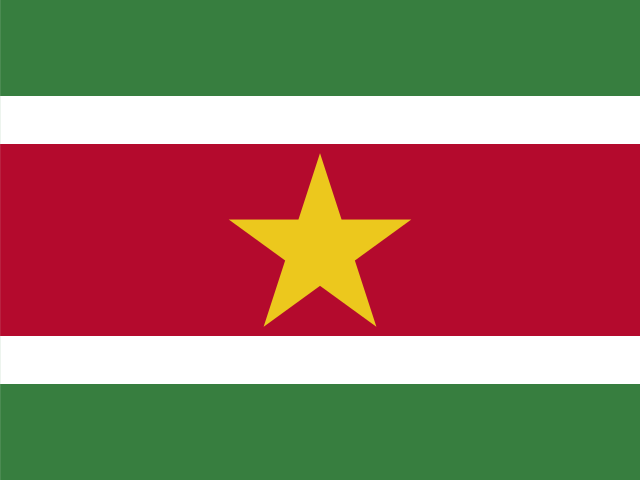
Suriname
Suriname · Americas · updated 22.08.2026
Suriname is the only country in South America with Dutch as its official state language (Algemeen Bureau voor de Statistiek, accessed 03.08.2026); Sranan Tongo, Javanese, Hindi and English are also widely spoken but have no official status. As a CARICOM member, Suriname applies a free-movement regime for skilled professionals: a national of another member country with a confirmed CARICOM Skills Certificate receives an indefinite stay status from the Vreemdelingendienst and is exempt from a work permit and from stay and settlement fees (resolution of 18.08.2004, S.B. 2004 no. 120). The separate category of "persons of Surinamese origin" — those born in Suriname, their descendants, and persons with PSA status under the Wet PSA (S.B. 2014 no. 08) — may apply directly for indefinite stay, bypassing the general five-year period; for all other foreigners, the switch to indefinite stay ("vestiging") opens up after 5 years of continuous legal residence (Vreemdelingenwet 1991). Naturalisation "bij wet" likewise requires 5 years of residence (art. 8 WNI); dual nationality is, as a general rule, not permitted — it is lost upon voluntary acquisition of another nationality (art. 11 WNI), and admission to Surinamese nationality is usually conditional on renouncing the prior one (art. 16b WNI). Importing pets requires a Veterinaire Inspectie veterinary import licence from the Ministry of Agriculture, Animal Husbandry and Fisheries (LVV), notification 72 hours before arrival, and quarantine whose duration is set individually for each application rather than fixed in advance. The country's economy stands on the threshold of offshore oil production: per an announcement by the Surinamese government (October 2024), TotalEnergies and APA Corporation took a final investment decision on the Gran Morgu project in Block 58 (investment of over USD 10.5 billion, target output 220,000 barrels per day, first oil expected in the first half of 2028; gov.sr, accessed 03.08.2026), against a backdrop of high inflation in recent years — according to the World Bank, consumer prices rose 59.1% in 2021 and stayed above 50% in 2022–2023, falling to 16.2% in 2024 and 9.2% in 2025. The country's population is concentrated almost entirely in Paramaribo and a narrow strip along the coast: the interior is tropical forest with almost no towns (Sipaliwini district, three-quarters of the country's area — 0.3 people per km² per the 2012 census). According to the CDC (updated 23.04.2025), local malaria transmission has not been recorded in Suriname since 2021, and preventive medication is not currently recommended even for the historically endemic interior districts near the border with French Guiana.
Some descriptions for this country are still Russian only: 86% translated. Numbers, prices and timelines are complete.
Entry
Entry rules depend on citizenship. Choose a passport to see the requirement for that one.
Work and visas
- Visa speed
- Applications for stay (verblijf) and settlement (vestiging) are processed within up to 60 working days; a naturalisation-by-marriage application within no more than 2 months from the notification date (art. 12(2) WNI per vz2.juspol.sr practice), plus a separate 7 working days for issuing the "Verklaring van Naturalisatie". An MKV abroad is processed within 3 months. Source: vz2.juspol.sr, sections /veel-gestelde-vragen and /machtiging-kortverblijf, accessed 03.08.2026.
Visa types: A residence permit for persons of Surinamese origin (Verblijf/Vestiging Surinaamse Origine) — a special regime for the "vreemdelingen van Surinaamse origine" category, defined by the Richtlijnen Toelating en Verblijf vreemdelingen Surinaamse Origine decree, S.B. 2016 no. 17: persons born in Suriname who now hold another nationality; persons covered by art. 2-4 of the Wet Nationaliteit en Ingezetenschap (WNI, G.B. 1975 no. 171, as last amended by S.B. 2014 no. 121) who now hold a foreign nationality; persons born outside Suriname to a parent born in Suriname; persons who once held Surinamese nationality and became stateless or foreign nationals; persons with PSA status under the Wet PSA (S.B. 2014 no. 08) — as well as the spouse and minor children of such persons. By virtue of their "special connection to Suriname", this category may, without waiting for the usual number of years of legal residence (unlike the general procedure for "overige vreemdelingen"), apply immediately after entry either for fixed-term stay (up to 2 years, "Verblijf Surinaamse Origine") or directly for indefinite stay ("Vestiging Surinaamse Origine"). Applications are filed with the Hoofdafdeling Vreemdelingenzaken of the Ministry of Justice and Police; the fee is USD 150 (fixed-term) or USD 200 (indefinite). Source: vz2.juspol.sr (Vreemdelingenzaken), sections /categoriesatie-van-vreemdelingen, /type-aanvragen, /veel-gestelde-vragen, accessed 03.08.2026. · The general procedure for "other foreigners" (Overige Vreemdelingen) — not of Surinamese origin and not CARICOM nationals: fixed-term stay of up to 2 years ("Verblijf Overige Vreemdelingen"). For a stay of more than 3 months for a purpose other than tourism/business, a Machtiging tot Kortverblijf (MKV) must be obtained in advance, before entry, at a Surinamese embassy or consulate abroad (art. 3 Vreemdelingenwet 1991 read with art. 12 Vreemdelingenbesluit 1995); on arrival — registration with the Vreemdelingendienst (KPS) within 8 days and filing a stay application within 14 days. The stay application is processed within no more than 60 working days; the fee is USD 150, and renewal is also USD 150. After 5 years of continuous, legal, primary residence in Suriname, a switch to indefinite stay is available ("Vestiging Overige Vreemdelingen", fee USD 200). Source: vz2.juspol.sr, sections /machtiging-kortverblijf, /type-aanvragen, /veel-gestelde-vragen, accessed 03.08.2026. · CARICOM Skills Certificate ("bekwame burgers", qualified CARICOM nationals) — Suriname is one of 15 CARICOM member states (alongside Antigua and Barbuda, the Bahamas, Barbados, Belize, Guyana, Grenada, Dominica, Jamaica, Montserrat, Saint Kitts and Nevis, Saint Lucia, Saint Vincent and the Grenadines, Trinidad and Tobago; caricom.org, accessed 03.08.2026). A national of another CARICOM country with a confirmed skills certificate registers it with the VVP Commission under the Ministry of Labour, Technological Development and Environment (ATM), after which they receive an indefinite stay status from the Vreemdelingendienst (KPS) — distinct from ordinary "vestiging": it allows free movement and residence in Suriname, but does not by itself make such a person an "ingezetene" (a resident for all legal purposes) unless they additionally obtain permanent settlement under the general rules. Qualified CARICOM nationals, like persons of Surinamese origin, are exempt from the requirement to hold a separate work permit (werkvergunning). Source: vz2.juspol.sr, sections /categoriesatie-van-vreemdelingen and /veel-gestelde-vragen ("De categorie Surinaamse Origine en CARICOM Skilled burgers zijn hiervan vrijgesteld"), accessed 03.08.2026. · Other (unskilled) CARICOM nationals — on entry, they receive a 6-month short stay (kortverblijf) without needing to obtain an MKV in advance (CARICOM nationals are exempt from this requirement), and within that period must file an application under the "verblijf overige" type. CARICOM nationals are also exempt from stay and settlement fees under the resolution of 18 August 2004 (S.B. 2004 no. 120) — except for naturalisation fees. Source: vz2.juspol.sr, sections /categoriesatie-van-vreemdelingen and /veel-gestelde-vragen, accessed 03.08.2026. · Work permit (werkvergunning) — a foreigner engaged in work activity in Suriname must hold a valid work permit; the categories "persons of Surinamese origin" and "qualified CARICOM nationals" are exempt from this requirement ("Indien vreemdelingen deelnemen aan het arbeidsproces, dienen zij in het bezit te zijn van een geldige werkvergunning. De categorie Surinaamse Origine en CARICOM Skilled burgers zijn hiervan vrijgesteld"). No separate portal of the relevant agency (the Ministry of Labour) describing the procedure for issuing the work permit itself could be found — this rule is recorded on the Vreemdelingenzaken side. Source: vz2.juspol.sr/veel-gestelde-vragen, accessed 03.08.2026.
Dutch is the country's only official language and the only national Dutch language in South America (Kerncijfers van Suriname, Algemeen Bureau voor de Statistiek, statistics-suriname.org, accessed 03.08.2026); other widely spoken languages — Sranan Tongo, Javanese, Hindi, English — have no official status.
Long-term visas and residence permits
Temporary residence for persons of Surinamese origin
RepatriationTemporary residence for other foreign nationals
OtherExtension of a residence permit
OtherPermanent settlement for persons of Surinamese origin
RepatriationPermanent settlement for other foreign nationals
OtherCo-settlement of a family member
FamilyShort-stay authorisation (MKV)
OtherShort stay for CARICOM nationals
OtherIndefinite stay for a CARICOM skilled national
WorkConversion of a pre-1991 residence permit
OtherApplication for a minor child
FamilyDuplicate of a residence or settlement permit
OtherNaturalisation
OtherProgramme terms change, and the final decision rests with the consulate or the country migration service. The data is collected from official sources on the date shown and is not legal advice.
Residence and citizenship
- Permanent residence after
- 5 years
- Citizenship after
- 5 years
- Dual citizenship
- not allowed
Dual citizenship: Dual/multiple nationality is, as a general rule, not permitted. Art. 11 WNI: Surinamese nationality is lost, among other things, upon voluntary acquisition of another nationality by the holder's own choice (para. 4) — automatically, with a narrow exception for a Surinamese woman who did not use her right to renounce a nationality automatically acquired through marriage; and upon entering foreign military or state service without the President's permission (para. 5). For admission to Surinamese nationality through naturalisation by presidential decree (art. 16a), the application is refused if the applicant, holding a foreign nationality, has not done what is possible to lose it, or is not prepared to do so after naturalisation — "tenzij dit redelijkerwijs niet kan worden verlangd" (except where this cannot reasonably be required) (art. 16b para. 1b). Source: Wet Nationaliteit en Ingezetenschap, text at dna.sr, media/xrtlapvw/wet_op_nationaliteit_en_ingezetenschap.pdf, accessed 03.08.2026.
The general procedure is naturalisation "bij wet" (art. 8 Wet Nationaliteit en Ingezetenschap, WNI, G.B. 1975 no. 171, as amended by S.B. 2002 no. 22 and S.B. 2014 no. 121; text at dna.sr, media/xrtlapvw/wet_op_nationaliteit_en_ingezetenschap.pdf, accessed 03.08.2026): the applicant must be an adult and either have lost Surinamese nationality, or have had their main place of residence in Suriname for the past five years (art. 8(4b)), or have been born in Suriname to stateless parents or parents of unknown nationality. A fee is paid to the treasury (historically SRD 200, with a reduced rate of SRD 80 for certain categories — art. 8(4c), (6)). A decision on a "bij wet" naturalisation application goes through a bill covering a minimum of 50 people, the Council of State and the National Assembly (practice per vz2.juspol.sr/type-aanvragen, accessed 03.08.2026). A separate route is naturalisation "bij resolutie" by presidential decree (art. 16a WNI) for persons of Surinamese origin (born in Suriname, once having held its nationality, or descendants of parents born in Suriname, as well as persons with PSA status under the Wet PSA S.B. 2014 no. 08), with no prior residence-period requirement, but conditional on residing in Suriname at the time of application (art. 16a(2b)); the application may be refused if the applicant has not done what is possible to lose their foreign nationality (art. 16b(1b)). Naturalisation by marriage (art. 12 WNI, as amended by S.B. 2014 no. 121, practice per vz2.juspol.sr/algemen-info-naturalisatie) is available through a notification ("kennisgeving") to the minister if one of the following conditions is met: the marriage has lasted at least 2 years and the spouses have shared the same address for 2 years; or the applicant had residence in Suriname for 5 or more years before the marriage; or children were born of the relationship. Separately, the WNI (art. 8(9)) provides that the conditions of "inburgering" (civic integration) as a condition of naturalisation are set by a separate state decree — whether such a decree is in force as of 03.08.2026 could not be confirmed in open sources, and no separate language test for the general naturalisation procedure was found in the text of the WNI.
Documents
- Document certification
- apostille
The country is party to the 1961 Hague Convention: a degree or certificate is authenticated with a single apostille in the country that issued it.
Family
Partner
- Timeline
- For naturalisation by marriage: the police check begins immediately after the notification is filed, and the applicant must report to the police at their place of residence within 10 working days of filing; once the police report is received, a draft decision is prepared for the minister's signature — the naturalisation certificate itself ("Verklaring van Naturalisatie") is issued within 7 working days from when all documents are on hand (vz2.juspol.sr/veel-gestelde-vragen). An older version of art. 12(2) WNI set a 2-month check of cohabitation from the date of notification. For "medevestiging" and ordinary residence applications — up to 60 working days (vz2.juspol.sr/veel-gestelde-vragen), accessed 03.08.2026.
No direct official data were found on a spouse's right to work before completing naturalisation or obtaining medevestiging — until then, legal employment is determined by the spouse's own basis of stay under the general rules (see work.visaTypes): a valid work permit (werkvergunning) is required, unless the spouse belongs to a category exempt from it (persons of Surinamese origin, qualified CARICOM nationals).
Parents
Partner's parents
Pets
- Limit
- no limit
The import of live animals is regulated by the veterinary service (Veterinaire Inspectie, Onderdirectoraat Veeteelt) of the Ministry of Agriculture, Animal Husbandry and Fisheries (LVV): a veterinary import licence ("veterinaire — importvergunning") is mandatory, issued by the head of the Veterinaire Inspectie on an application with supporting documents; the application is checked for completeness, for compliance with ministry policy, and finally on veterinary-sanitary grounds — assessing whether the import is safe for human and animal health in Suriname. Processing takes 3 to 15 working days from submission of the complete set of documents. Veterinaire Inspectie must be notified at least 72 hours before the arrival of animals or products in Suriname for a veterinary inspection at the airport/port. For live animals, once inspection and approval are complete, the permit notes that the animals may be transported to a quarantine location agreed in advance between the Veterinaire Inspectie and the applicant; if disease is detected during quarantine, the animal may be treated or euthanised at the decision of the supervising officials together with the head of the Veterinaire Inspectie, and the set quarantine period may be extended at the head's discretion — a fixed quarantine duration is not stated in the document. A rabies antibody titre requirement and timeframes specifically for dogs/cats as a separate category (as distinct from the general regime for any animal) are not addressed in the sources found — left blank as not yet gathered, not as "no requirement". Source: "Procedure voor de import en doorvoer van dieren, producten van dierlijke oorsprong, diergeneesmiddelen en diervoeder", Ministerie van Landbouw, Veeteelt en Visserij, Onderdirectoraat Veeteelt — the official domain lvv.gov.sr returns an empty, contentless directory as of 03.08.2026; a Wayback Machine snapshot from 30.11.2021 was used (web.archive.org/web/20211130002107/http://lvv.gov.sr/media/1085/regels-voor-de-import-en-doorvoer-van-dieren-producten-van-dierlijke-oorsprong-diergeneesmiddelen-en-diervoeder.pdf).
Safety
Climate
Quality of life
Cities
Paramaribo
The capital and unquestionably the country's largest city: 240,924 people by Paramaribo district (2012 census, Algemeen Bureau voor de Statistiek, Statistisch Jaarboek 2016/2017, table 3.1) — about 44% of Suriname's entire population at that time (541,638 people per the same census). The sole location of the government, ministries and diplomatic missions; outside the capital agglomeration and the narrow coastal strip there are only scattered settlements in the interior tropical forest — Sipaliwini district (130,567 km², more than three-quarters of the country's area) had, per the same census, a density of 0.3 people per km².
A low-lying coast: Suriname scores 8.6 out of 10 on the INFORM flood-risk index (indicators.riskFlood). According to the General Bureau of Statistics, rainfall in the rainy season exceeds 480 mm in May (climate.monthlyRainMm). Official police statistics record the highest absolute number of registered crimes precisely in Paramaribo district — 11,134 of the country's 23,435 in 2016, mostly property crimes (Ministerie van Justitie en Politie, Statistisch Jaarboek ABS 2016/2017, table 13.1a) — which is expected given such a population concentration.
Lelydorp
A suburb of Paramaribo in Wanica district on the road to Johan Adolf Pengel International Airport: 18,663 people by ressort Lelydorp (2012 census, ABS, Statistisch Jaarboek 2016/2017, table 3.1) — the second-largest settlement in the capital agglomeration after Paramaribo itself. Livingcost.org does not track the city separately (the site publishes data only for Paramaribo and Nieuw Nickerie) — rent and utilities prices are left blank rather than estimated.
No separate data on specific risks for this city were found; see the naturalRisks and indicators sections for country-wide figures.
Nieuw Nickerie
The country's second-largest standalone town and the administrative centre of Nickerie district: 12,818 people by ressort Nieuw Nickerie (2012 census, ABS, Statistisch Jaarboek 2016/2017, table 3.1). Centre of a rice-growing district on the border with Guyana, on the eastern bank of the Corantijn River (ferry crossing). The only Suriname city besides Paramaribo for which livingcost.org publishes separate price data.
No separate data on specific risks for this city were found; see the naturalRisks and indicators sections for country-wide figures.
Moengo
The largest settlement in Marowijne district: 10,834 people by ressort Moengo (2012 census, ABS, Statistisch Jaarboek 2016/2017, table 3.1) — a historic centre of bauxite mining and processing in the east of the country. Livingcost.org does not track the city — rent and utilities prices are left blank.
An interior border area near French Guiana: according to the CDC Yellow Book (updated 23.04.2025, wwwnc.cdc.gov, accessed 03.08.2026), local malaria transmission has not been recorded in Suriname since 2021 and preventive medication is not currently recommended, but the districts of Marowijne, Sipaliwini, Brokopondo and Para (near the border with French Guiana) were historically the country's malaria-endemic zones.
Albina
A border town of Marowijne district on the Marowijne River: 5,247 people by ressort Albina (2012 census, ABS, Statistisch Jaarboek 2016/2017, table 3.1). A ferry connects it across the river to the town of Saint-Laurent-du-Maroni in French Guiana (EU). Livingcost.org does not track the city — rent and utilities prices are left blank.
An interior border area: according to the CDC Yellow Book (updated 23.04.2025, accessed 03.08.2026), local malaria transmission has not been recorded in Suriname since 2021, but Marowijne district was historically part of the malaria-endemic zone near the border with French Guiana.
Grocery basket
- Bread, 500 g
- $ 1,38
- Milk, 1 l
- $ 1,82
- Eggs, 12
- $ 3,04
- Chicken breast, 1 kg
- $ 6,20
- Cheese, 1 kg
- $ 11,0
- Rice, 1 kg
- $ 1,64
- Potatoes, 1 kg
- $ 1,38
- Apples, 1 kg
- $ 4,89
- Coca-Cola / Pepsi, 2 l
- $ 2,21
- Total
- $ 33,6
The same set for every country, so the comparison is fair.
Cost of living across the country
- Rent, 1 bedroom
- $ 394 a month
- Rent, 3 bedrooms
- $ 1 149 a month
- Utility bills
- $ 35,5 a month
- Home internet
- $ 30,3 a month
- Monthly transport pass
- $ 90,7 a month
- Single transport ticket
- $ 0,59
- Petrol, litre
- $ 1,16
- Cold medicine
- $ 10,4 for a week
Country averages. City prices, where collected, are shown above and are more precise.
Indicators
- Life expectancy
- 73,8 years2024
- Homicides
- 4,3 per 100k2024
- Road deaths
- 16,2 per 100k2021
- Unemployment
- 7,8 %2025
- Unemployment, ages 15–24
- 25,4 %2025
- Inequality (Gini)
- 39,22022
- Health spending per person
- $ 297 a year
- Air pollution, PM2.5
- 15,7 µg/m³2023
- Access to clean water
- 98 %2024
- Internet, fixed line
- 160,8 Mbit/s2026
Governance
- Political stability
- above average · 0,5
- Control of corruption
- below average · -0,4
- Rule of law
- below average · -0,2
- Government effectiveness
- below average · -0,5
World Bank estimates on a −2.5 to +2.5 scale, higher is better.
Natural hazards
- Earthquakes
- 0,1 out of 10
- River floods
- 8,6 out of 10
- Coastal floods
- 1,5 out of 10
- Tropical cyclones
- 0 out of 10
- Droughts
- 1,7 out of 10
- Tsunamis
- 0 out of 10
Each value carries the year it refers to. “Data lags behind” means this country's figure was collected noticeably earlier than the rest. Natural hazards use one 0–10 scale and are meant to be compared against each other.
Pros and cons
Compare with other countries in the region
Bahamas · Belize · Bolivia · Colombia · Costa Rica · Cuba · Dominican Republic · Ecuador · El Salvador · Falkland Islands · Greenland · Guatemala · Guyana · Haiti · Honduras · Jamaica · Nicaragua · Panama · Paraguay · Peru · Puerto Rico · Trinidad and Tobago · Venezuela
Other countries in the region: Americas
Bahamas · Belize · Bolivia · Colombia · Costa Rica · Cuba · Dominican Republic · Ecuador · El Salvador · Falkland Islands · Greenland · Guatemala · Guyana · Haiti · Honduras · Jamaica · Nicaragua · Panama · Paraguay · Peru · Puerto Rico · Trinidad and Tobago · Venezuela