Jamaica or Suriname
Two countries side by side across the same rows as the full comparison. A dash means the value is missing: fields are not filled with guesses. about the data
| Jamaica | Suriname | |
|---|---|---|
| Salary in IT | — | — |
| Citizenship | 5 years | 5 years |
| Partner can work | yes | — |
| Parents | — | — |
| Pets | difficult | difficult |
| Pet limit | no limit | no limit |
| Quarantine | 14 days | — |
| Residence permit fee | — | — |
| Rent, 2 bedrooms | $ 1 149 · estimate | $ 530 · estimate |
| Basket | $ 40,0 | $ 33,6 |
| Life expectancy | 71.61 | 73.76 |
| Homicides/100k | 40.36 | 4.26 |
| Natural hazards, 0–10 | 5 | 3.4 |
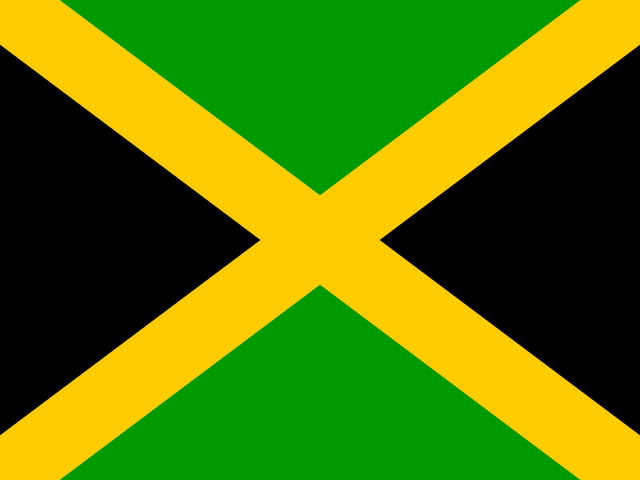
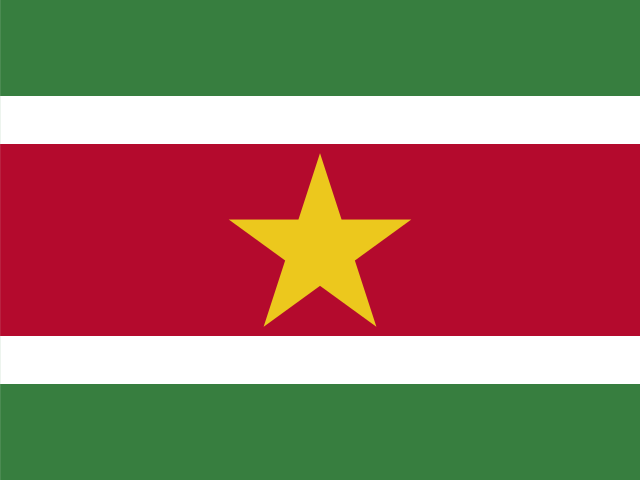
How the two sets of routes differ
Long-stay routes in this reference: Jamaica — 18, Suriname — 13. Types present in both: work, family and repatriation. Jamaica adds: study and retirement.
Fees, thresholds and deadlines
Jamaica: fees range from 2,000 to 100,000 JMD. Routes with a published decision deadline: 11; the shortest is 3 days. Suriname: fees range from 10 to 250 USD.
Beyond the first permit
Permanent status: Jamaica after 3 years, Suriname after 5 years. Citizenship: both after 5 years. Jamaica allows a second citizenship, Suriname does not.
Jamaica in brief
Jamaica is the most populous English-speaking island in the Caribbean, with an economy built on tourism (Montego Bay and Negril are the main resort destinations), the bauxite industry, and diaspora remittances. A work permit for foreigners is required under the Foreign Nationals and Commonwealth Citizens (Employment) Act and is issued by the Ministry of Labour and Social Security; CARICOM nationals holding a CARICOM Skills Certificate work without a permit under the CSME free movement of skilled persons regime. Permanent residence through employment is available after more than 3 years of work in the country; naturalisation requires 5 years of cumulative residence, and citizenship by marriage to a Jamaican citizen can be applied for immediately after the marriage is registered. Dual citizenship is permitted without restriction to a list of countries. Importing dogs and cats is mandatory through the sole legal port of entry (Kingston), with 14-day quarantine and a mandatory rabies antibody test (FAVN) regardless of country of origin — no exemption for 'rabies-free countries' was found. The homicide rate is one of the highest in the world, 40.36 per 100,000 population (UNODC, 2024). The territory lies within the tropical cyclone season zone (June–November, INFORM risk 8.2 out of 10) — in 2026, Hurricane Melissa affected seven parishes and over a third of the country's population — and in a seismically active part of the Caribbean (INFORM earthquake risk 7.9 out of 10).
Suriname in brief
Suriname is the only country in South America with Dutch as its official state language (Algemeen Bureau voor de Statistiek, accessed 03.08.2026); Sranan Tongo, Javanese, Hindi and English are also widely spoken but have no official status. As a CARICOM member, Suriname applies a free-movement regime for skilled professionals: a national of another member country with a confirmed CARICOM Skills Certificate receives an indefinite stay status from the Vreemdelingendienst and is exempt from a work permit and from stay and settlement fees (resolution of 18.08.2004, S.B. 2004 no. 120). The separate category of "persons of Surinamese origin" — those born in Suriname, their descendants, and persons with PSA status under the Wet PSA (S.B. 2014 no. 08) — may apply directly for indefinite stay, bypassing the general five-year period; for all other foreigners, the switch to indefinite stay ("vestiging") opens up after 5 years of continuous legal residence (Vreemdelingenwet 1991). Naturalisation "bij wet" likewise requires 5 years of residence (art. 8 WNI); dual nationality is, as a general rule, not permitted — it is lost upon voluntary acquisition of another nationality (art. 11 WNI), and admission to Surinamese nationality is usually conditional on renouncing the prior one (art. 16b WNI). Importing pets requires a Veterinaire Inspectie veterinary import licence from the Ministry of Agriculture, Animal Husbandry and Fisheries (LVV), notification 72 hours before arrival, and quarantine whose duration is set individually for each application rather than fixed in advance. The country's economy stands on the threshold of offshore oil production: per an announcement by the Surinamese government (October 2024), TotalEnergies and APA Corporation took a final investment decision on the Gran Morgu project in Block 58 (investment of over USD 10.5 billion, target output 220,000 barrels per day, first oil expected in the first half of 2028; gov.sr, accessed 03.08.2026), against a backdrop of high inflation in recent years — according to the World Bank, consumer prices rose 59.1% in 2021 and stayed above 50% in 2022–2023, falling to 16.2% in 2024 and 9.2% in 2025. The country's population is concentrated almost entirely in Paramaribo and a narrow strip along the coast: the interior is tropical forest with almost no towns (Sipaliwini district, three-quarters of the country's area — 0.3 people per km² per the 2012 census). According to the CDC (updated 23.04.2025), local malaria transmission has not been recorded in Suriname since 2021, and preventive medication is not currently recommended even for the historically endemic interior districts near the border with French Guiana.
Other comparisons
More on each: Jamaica · Suriname. Build your own comparison — up to four countries
This material is for reference and is not legal, tax or immigration advice. Visa rules, tax thresholds and prices change. Before deciding anything, check the official sources and consult a licensed professional in the relevant country.