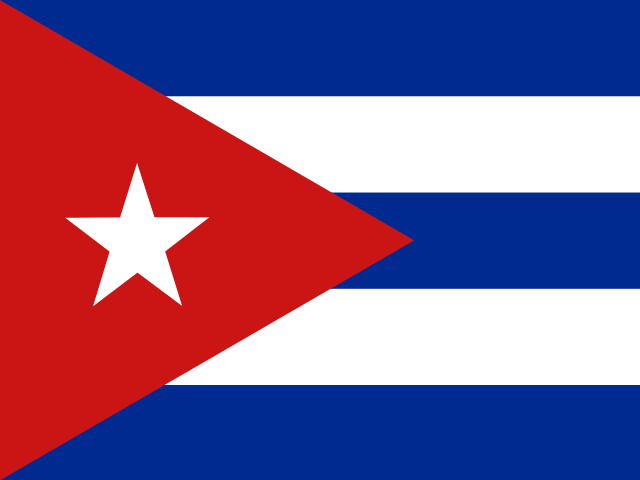
Cuba
Cuba · Americas · updated 22.08.2026
Cuba combines things rarely found together in this set: high life expectancy and clean air alongside expensive communications and utilities. Life expectancy is 78.26 years and mean PM2.5 concentration just 9.45 micrograms per cubic metre — one of the best figures in this guide; basic access to water reaches 95.15 per cent of the population. Road deaths at 5.4 per 100,000 are likewise among the lowest. On the World Bank scale from −2.5 to +2.5, political stability stands at +0.32 (a positive value is rare here), control of corruption at −0.23, government effectiveness at −0.27 and rule of law at −0.62. Overall natural risk is 4.8 out of 10 on INFORM and almost entirely weather-driven: cyclones 8.0, coastal risks 5.7, earthquakes 5.0, against floods at just 0.5. Prices are distributed unusually: internet at 68.65 dollars a month and utilities at 94.11, against a transport pass at 41.6 and fuel at 1.37. The immigration framework was rewritten wholesale by the 2024 laws — on Migration (171), Citizenship (172) and Foreigners (173) — and published together with their regulations in the official gazette. It rests on one principle: a foreigner holds exactly one migratory classification at any time, and everything else follows from it, including the right to work. A work permit is required of temporary residents and real-estate residents, but not at all of provisional and permanent residents. The route to permanent status necessarily passes through the provisional resident stage, granted for up to a year precisely to verify social integration; a refusal at that stage bars a further attempt for two years. Permanent residence is granted after five years of residence under a resident classification, or with no qualifying period on grounds of marriage to a citizen, kinship with a citizen by birth, high qualification or substantial assets; it is approved for five years and renewed until the age of sixty, after which it runs indefinitely. The authority publishes concrete standards: up to 180 working days to consider a permanent residence file and up to 60 days for the decision, three working days for the real-estate resident classification, 15 calendar days for the applicant to remedy deficiencies and 10 days after entry to register. What this data does not contain: the population of Havana is not given, as no official source separating city from province could be found; the country's second city is not included in this guide because the price source reports a one-bedroom flat there at three times the cost of a three-bedroom one, so that data is plainly corrupted.
Some descriptions for this country are still Russian only: 87% translated. Numbers, prices and timelines are complete.
Entry
Entry rules depend on citizenship. Choose a passport to see the requirement for that one.
Work and visas
- Visa speed
- The standards are published and quite specific. On an application for permanent residence a file is opened for each application and considered within up to 180 WORKING days of receipt; the decision is issued by resolution within up to 60 days. If the application has deficiencies, up to 15 calendar days are allowed to remedy them, and if that period is missed the application is deemed withdrawn and the file is closed. Under the “real-estate resident” classification the decision is taken within three working days of the file being completed. Timeframes for the applicant themself are set out separately: resident foreigners must register in the Register of Foreigners and in the migration register within ten calendar days of entry. Anyone refused permanent residence may not file a new application until two years have passed since the last refusal, and must leave the country. A note on timing: this is the procedure under Laws 171–173 and their decrees, which enter into force on 1 November 2026; until that date the earlier legislation of 1976 applies.
Visa types: WHEN THIS TAKES EFFECT. Everything described below is the new migration legislation: Laws 171 on Migration, 172 on Citizenship and 173 on Foreigners, passed by the National Assembly on 19 July 2024, and the regulations to them (Decrees 136/2025 and 137/2025). They were first published only on 5 May 2026 — “Gaceta Oficial” No. 39 — and each of the five instruments states in its final provisions that it enters into force on the one hundred and eightieth day after publication. That is 1 November 2026. Until that date Laws 1312 and 1313 of 1976, together with Decree 27/1978, which the new instruments repeal, formally continue to apply. · How the system works: a foreigner holds EXACTLY ONE migratory classification at any moment and, while in the country, may apply to change it. The classifications fall into two categories — non-residents and residents — and the classification determines both the right to work and the renewal procedure. · Non-residents. Visitors (visitantes) — short trips with a specific purpose on the corresponding visa; the subclassifications include tourist, transient (transeúnte), transit or transfer passenger, and participant in a non-governmental event. Diplomats — accredited persons. Invitees (invitados) — those invited by the state, the government, the Central Committee of the Communist Party, the Union of Young Communists, or mass and professional organisations. · A tourist may be permitted activities other than leisure, but only through an authorisation from the Specialised Body for Foreigners, requested by a travel agency, tour operator, airline, hotel or the tourist themselves; such an authorisation runs for no more than 30 calendar days. · Temporary resident (residente temporal) — foreigners admitted for a determined period for authorised activities. Any professional or work activity requires a work permit from the Ministry of Labour and Social Security. · Real-estate resident (residente de inmobiliaria) — owners and tenants of housing in residential complexes or standalone buildings intended for that purpose, and the foreign relatives living with them. A work permit is also required. The classification is cancelled on loss of ownership or tenancy — and the relatives living in that housing lose it too — as well as on leaving the country for more than a year. · Humanitarian resident (residente humanitario) — those under the care of the UNHCR office in Havana, persons in a vulnerable situation and those needing temporary protection. To work they need both prior approval from the authority and a work permit. · Provisional resident (residente provisional) — the key stage: it is granted to those applying for permanent residence, and **it is a mandatory precondition for obtaining it**. It is given for up to one year and is intended to verify the applicant's proper social integration. It allows any authorised work activity WITHOUT a work permit. · Permanent resident (residente permanente) — those admitted to establish permanent domicile. The classification is approved for five years and renewed successively for the same term until the age of sixty, after which it runs indefinitely. No work permit is required. The condition for keeping it: within a year of approval the holder must achieve "effective migratory residence" — that is, spend the greater part of the preceding year in the country.
The right to work in Cuba is tied not to a separate document but to the migratory classification itself, and that is the main thing to grasp in advance. A work permit from the Ministry of Labour and Social Security is required of temporary residents and real-estate residents; humanitarian residents also need prior approval from the authority. But **provisional and permanent residents need no permit whatsoever** — they work on the general terms of the labour code. The second thing that shapes the procedure: a foreigner holds exactly one classification at any moment, and changing it is a separate procedure. The move to permanent residence goes only through the provisional resident stage, which is granted for up to a year precisely to verify social integration. A refusal at that stage bars a further application for two years and obliges the person to leave the country. A note on timing: this is the procedure under Laws 171–173 and their decrees, which enter into force on 1 November 2026; until that date the earlier legislation of 1976 applies. Common to all subclasses of TEMPORARY residence: any professional or work activity lasting more than 30 calendar days requires a work permit from the Ministry of Labour and Social Security (art. 112 of Decree 136/2025, arts. 66 and 68 of Decree 137/2025); the term matches the authorised activity and may not exceed five years, longer only on a reasoned petition from the receiving Cuban organisation filed 30 calendar days before expiry (art. 111 and art. 53); a case is handled within 90 working days and the decision is communicated within three working days of its completion (art. 115); the petition is filed by the accredited head of the receiving organisation, not by the foreigner (art. 114); losing the link with that organisation before the term expires annuls the classification and obliges the person to leave the country (art. 122); the spouse, minor children and dependent relatives receive the same subclass for as long as the principal holder keeps it (art. 108). Common to PROVISIONAL and PERMANENT residence: the classification is approved for five years and renewed successively for the same term up to the age of sixty, after which it is renewed indefinitely (art. 148.1); no work permit is required (arts. 148.2 and 95.2); the procedure has two stages — up to 180 working days for the decision on provisional residence (art. 151), then a year of provisional residence and up to 60 working days for the decision on permanent residence (art. 154), and it is the second of these that the processing-time field carries; the condition for keeping it is to achieve «effective migratory residence» within a year of approval, that is to spend the greater part of the preceding year in the country (art. 48 of the law, arts. 42–43 of the Regulation), and losing that condition annuls the classification; being absent from the country for more than a year in a row costs the status (art. 54 of the law); a refusal bars a further application for two years. All the rules listed above were printed for the first time in issue No. 39 of «Gaceta Oficial» of 05.05.2026 and enter into force on the 180th day after publication, that is on 01.11.2026.
Long-term visas and residence permits
Temporary resident — technicians and scientists
WorkTemporary resident — students and scholarship holders
StudyTemporary resident — professional artists
TalentTemporary resident — athletes and sports delegations
TalentTemporary resident — journalists and correspondents
WorkTemporary resident — religious workers
OtherTemporary resident — traders and trusted officers
WorkTemporary resident — employees of foreign entities
WorkTemporary resident — investors and business people
InvestmentTemporary resident — international cooperation workers
OtherTemporary resident — accompanying family member
FamilyReal-estate resident
InvestmentHumanitarian resident — UNHCR caseload
OtherHumanitarian resident — vulnerable person
OtherHumanitarian resident — temporary protection
OtherProvisional resident
OtherProvisional resident — Cuban citizenship recovery
RepatriationPermanent resident — family of a Cuban citizen
FamilyPermanent resident — parent of a Cuban citizen by birth
FamilyPermanent resident — five years of prior residence
OtherPermanent resident — high qualification or international standing
TalentPermanent resident — substantial assets
InvestmentPermanent resident — qualified workers and families
WorkPermanent resident — business and investment assets
InvestmentFamily reunification requested by a Cuban citizen
FamilyProgramme terms change, and the final decision rests with the consulate or the country migration service. The data is collected from official sources on the date shown and is not legal advice.
Residence and citizenship
- Permanent residence after
- 5 years
Permanent residence is granted on one of the grounds listed in Articles 49 and 50 of Law 171 on Migration of 2024. The general route is to have lived in the country for more than FIVE YEARS under one of the resident classifications and to hold “effective migratory residence” at the time of filing; hence the value of this field. The other grounds require no qualifying period: a family formed by marriage or a de facto union (notarised, or judicially recognised and registered) with a Cuban citizen who has effective residence in the country, including minor children and grandchildren of foreign parents within the family unit; parents of a Cuban citizen by birth who has effective residence; foreigners with confirmed high professional qualification or international recognition in science, sport, culture and the arts; foreigners with substantial assets abroad or in a Cuban bank. Article 50 adds two more: foreigners and families with occupational qualifications and the economic standing to secure their settlement, and foreigners with assets for running a business or for investment in priority development projects. A mandatory condition of the route is the prior stage of provisional resident (residente provisional). Citizenship by naturalisation requires five years of permanent residence, and two years for the spouse or parent of a Cuban citizen by birth. Source: Law 171 on Migration, Law 173 on Foreigners and the regulations to them, “Gaceta Oficial” No. 39 of 2026. A note on timing: this is the procedure under Laws 171–173 and their decrees, which enter into force on 1 November 2026; until that date the earlier legislation of 1976 applies.
Documents
- Document certification
- consular legalisation
The country does not accept apostilles: documents go through consular legalisation in three steps — ministry of justice, foreign ministry, consulate.
Family
Partner
- Timeline
- Up to 180 working days to consider the file and up to 60 days to issue the decision by resolution — this is the standard for an application for permanent residence, which is what the family ground falls under. Applications from spouses and their minor children may be filed in a single document. Where the application is deficient, up to 15 calendar days are allowed to remedy it; missing that deadline is treated as withdrawal.
Parents
Partner's parents
Pets
- Limit
- no limit
- Quarantine
- no
- Antibody titre test
- not needed
The form is bilingual, English and Spanish. The veterinarian certifies that the animal is free of contagious disease, including rabies, canine and feline parvovirus, canine hepatitis and external parasites. Rabies vaccination is framed as a choice between two mutually exclusive attestations: either it was given, or the veterinarian certifies that no vaccine was administered at all — so it is not mandatory. A separate condition concerns the animal's history: it must not have been imported into the country of departure within the six months before dispatch (or must have been there since birth). An attestation is also required that there have been no cases of rabies in the country of departure other than those caused by European Bat Lyssavirus. The certificate is valid for seven days from the date of signature. The import permit number is marked in the form as "if applicable", so it is not an unconditional requirement. Antibody titration, quarantine on arrival and banned breeds are not mentioned in the document. No source of the country's own on importing cats and dogs could be found, so the requirements are read from a document issued on the other side of the border, with explicit attribution: the British export health certificate (DEFRA/APHA) — a description of the receiving side's requirements drawn up for export from the United Kingdom. Some of its conditions relate to the United Kingdom itself (the animal's residence there before export, the country's status as free of rabies) and are replaced, when leaving another country, by that country's own equivalents; the values set by the receiving side, however, do not depend on the country of departure. Read on 07.08.2026.
Safety
Climate
Quality of life
Cities
Havana
The capital and the only city in the country where all immigration formalities are concentrated: the Directorate of Identification, Migration, Foreigners and Citizenship, the UNHCR office and the diplomatic missions.
The country's principal hazard is tropical cyclones, at 8.0 out of 10 on INFORM, and Havana sits on the northern coast directly in their path; coastal risks stand at 5.7. Seismicity is moderate (5.0) and national flood risk is low at 0.5. Separately from nature: power outages are systemic, and a month of internet costs 68.65 dollars against national utilities of 94.11.
Grocery basket
- Bread, 500 g
- $ 1,72
- Milk, 1 l
- $ 2,66
- Eggs, 12
- $ 3,85
- Chicken breast, 1 kg
- $ 10,2
- Cheese, 1 kg
- $ 8,54
- Rice, 1 kg
- $ 2,04
- Potatoes, 1 kg
- $ 3,09
- Apples, 1 kg
- $ 5,46
- Coca-Cola / Pepsi, 2 l
- $ 4,80
- Total
- $ 42,4
The same set for every country, so the comparison is fair.
Cost of living across the country
- Rent, 1 bedroom
- $ 692 a month
- Rent, 3 bedrooms
- $ 892 a month
- Utility bills
- $ 94,1 a month
- Home internet
- $ 68,7 a month
- Monthly transport pass
- $ 41,6 a month
- Single transport ticket
- $ 0,72
- Petrol, litre
- $ 1,37
- Cold medicine
- $ 11,5 for a week
Country averages. City prices, where collected, are shown above and are more precise.
Indicators
- Life expectancy
- 78,3 years2024
- Homicides
- 4,5 per 100k2019 · data lags behind
- Road deaths
- 5,4 per 100k2021
- Unemployment
- 1,8 %2025
- Unemployment, ages 15–24
- 4,3 %2025
- Health spending per person
- $ 1 199 a year
- Air pollution, PM2.5
- 9,5 µg/m³2023
- Access to clean water
- 95,2 %2024
Governance
- Political stability
- above average · 0,3
- Control of corruption
- below average · -0,2
- Rule of law
- below average · -0,6
- Government effectiveness
- below average · -0,3
World Bank estimates on a −2.5 to +2.5 scale, higher is better.
Natural hazards
- Earthquakes
- 5 out of 10
- River floods
- 0,5 out of 10
- Coastal floods
- 5,7 out of 10
- Tropical cyclones
- 8 out of 10
- Droughts
- 3,7 out of 10
- Tsunamis
- 3,3 out of 10
Each value carries the year it refers to. “Data lags behind” means this country's figure was collected noticeably earlier than the rest. Natural hazards use one 0–10 scale and are meant to be compared against each other.
Compare with other countries in the region
Bahamas · Belize · Bolivia · Colombia · Costa Rica · Dominican Republic · Ecuador · El Salvador · Falkland Islands · Greenland · Guatemala · Guyana · Haiti · Honduras · Jamaica · Nicaragua · Panama · Paraguay · Peru · Puerto Rico · Suriname · Trinidad and Tobago · Venezuela
Other countries in the region: Americas
Bahamas · Belize · Bolivia · Colombia · Costa Rica · Dominican Republic · Ecuador · El Salvador · Falkland Islands · Greenland · Guatemala · Guyana · Haiti · Honduras · Jamaica · Nicaragua · Panama · Paraguay · Peru · Puerto Rico · Suriname · Trinidad and Tobago · Venezuela