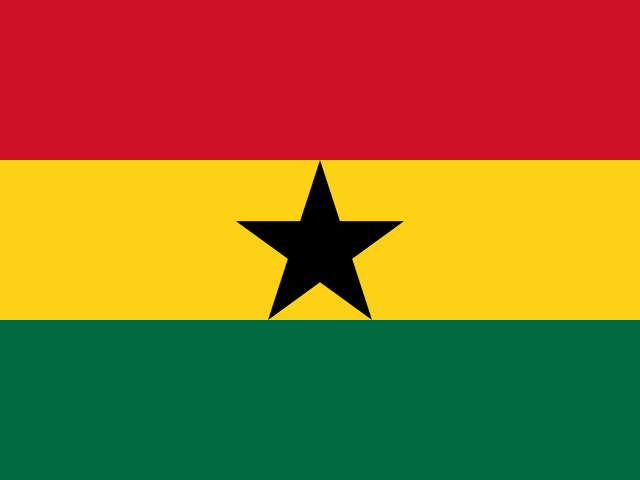
Ghana
Ghana · Africa · updated 21.08.2026
Ghana is a West African country with English-language law based on the Immigration Act, 2000 (Act 573) and the Citizenship Act, 2000 (Act 591), which has allowed dual citizenship since 2000. Work immigration is structured through the Ghana Immigration Service's 'Work and Residence Permit' combination and, for investors, an automatic GIPC/GIPA immigrant quota sized to the company's paid-up capital. A distinctive feature of the country is two official channels for the diaspora of African descent: the Right of Abode permanent-residence status and a state citizenship programme launched in 2016 and continued by the Year of Return 2019 campaign. Importing dogs and cats does not require quarantine, but does require laboratory confirmation of the absence of several infections and current vaccination. Of the country's five largest districts by the 2021 census, one — Cape Coast — is also a UNESCO World Heritage Site tied to the history of the transatlantic slave trade.
Some descriptions for this country are still Russian only: 83% translated. Numbers, prices and timelines are complete.
Entry
Entry rules depend on citizenship. Choose a passport to see the requirement for that one.
Work and visas
Visa types: Visa on arrival / emergency entry visa (Visa On Arrival / Emergency Entry Visa) · Transit visa (Transit Visa) · Re-entry visa (Re-Entry Visa) · Student residence permit (Residence Permit — Student) · Work and residence permit for companies (Work and Residence Permit — Companies) · Work and residence permit for missionaries/NGOs/GIPC immigrant-quota holders/shareholders (Work and Residence Permit — Missionaries/NGOs/Immigrant Quota GIPC/Shareholders) · Dependant residence permit, including for a spouse (Residence Permit — Dependant) · Indefinite residence permit (Indefinite Residence Status Generally) · The right of permanent residence for persons of African descent (Right of Abode) · Automatic immigrant quota for investors via GIPC (Automatic Immigrant Quota, GIPC Act, 2013, Act 865)
Unlike its regional neighbours, Ghana has two separate official pathways for the diaspora of African descent. (1) Right of Abode (gis.gov.gh) — an indefinite residence status without a visa or work permit; granted by the minister with the president's approval to two categories: Ghanaians by birth/adoption/registration/naturalisation who lost their citizenship on acquiring a foreign one, and persons of African descent from the diaspora (Ghanaian sponsors are required; for the diaspora, evidence of economic contribution is also required). This is a residence status, not citizenship. (2) The Ghana Citizenship Program (diasporaaffairs.gov.gh, the Office of Diaspora Affairs under the Presidency) — a separate programme granting citizenship itself to persons of African descent; launched on 28 December 2016 with the 'Right to Return' project (35 descendants of enslaved Africans received citizenship at the time) and linked to the Year of Return 2019 campaign. The investor immigrant quota via GIPC (Ghana Investment Promotion Centre Act, 2013, Act 865) grants automatic work-plus-residence permits scaled to paid-up capital: 1 quota place for $50–250 thousand, 2 for $250–500 thousand, 3 for $500–700 thousand, 4 for $700 thousand+; the quota covers the holder themselves, their spouse, and minor children (gipc.gov.gh/labour-expatriate-employment/). As of July–August 2026, GIPC is being renamed GIPA (Ghana Investment Promotion Authority) — the authority's website already carries a new copyright notice and the news item 'GIPC Now an Authority' (22 July 2026), while still linking to Act 865 (2013); a separate text of the new GIPA act was not found on the site at the time of collection.
Long-term visas and residence permits
Work and residence permit (companies)
WorkWork and residence permit (missionaries and NGOs)
WorkResidence permit under the GIPC automatic quota
InvestmentResidence permit under the immigrant quota
InvestmentResidence permit for shareholders
InvestmentFree zone residence permit
WorkResidence permit (student)
StudyResidence permit (dependant)
FamilyIndefinite residence status
OtherIndefinite residence status for the spouse of a Ghanaian
FamilyRight of Abode
RepatriationVisa on arrival / emergency entry visa
OtherVisa or permit extension
OtherTransit visa
OtherRe-entry visa
OtherAliens identity card
OtherProgramme terms change, and the final decision rests with the consulate or the country migration service. The data is collected from official sources on the date shown and is not legal advice.
Residence and citizenship
- Citizenship after
- 5 years
- Language
- Proficiency in a language indigenous to Ghana (Twi, Ewe, Ga, Nzema, etc.) is required — explicitly stated for the state diaspora citizenship programme (diasporaaffairs.gov.gh/citizenship); not separately confirmed by a primary source for the general naturalisation procedure under Act 591.
- Dual citizenship
- allowed
Dual citizenship: Dual citizenship has been permitted in Ghana since the Citizenship Act, 2000 (Act 591) was adopted — before that, acquiring foreign citizenship automatically stripped Ghanaian citizenship (this is confirmed by GIS itself: the Right of Abode status is explicitly addressed to Ghanaians 'who have lost their citizenship through the acquisition of a foreign one', i.e. it deals with the legacy of the pre-reform rule). Renouncing citizenship is now a purely voluntary procedure: the Ghana High Commission in London (ghanahighcommissionuk.com / london.mfa.gov.gh) describes 'Renunciation of Citizenship' as a separate application to the Minister of the Interior, not an automatic consequence of obtaining another passport.
The direct text of the Citizenship Act, 2000 (Act 591) could not be found (the law-aggregator domain laws.ghanalegal.com does not exist, ghalii.org returns a Cloudflare block on act pages, and the ILO NATLEX and Refworld sites block automated requests). The official state citizenship programme for the diaspora (diasporaaffairs.gov.gh/citizenship, Office of Diaspora Affairs under the Presidency) requires continuous residence in Ghana for at least 5 of the last 7 years, including 12 consecutive months immediately before filing; knowledge of a local Ghanaian language and evidence of cultural assimilation; a clean criminal record; and a contribution to Ghana's development. This matches the structure (5 of 7 plus a continuous year) of the general naturalisation procedure as described in open sources ('six years of residence' and a local-language requirement), so the figure is given as a reference point rather than a norm verified against the primary source — see citizenshipExtra.
The Ghana Citizenship Program for the diaspora of African descent is not general naturalisation but a separate track administered by the Office of Diaspora Affairs under the Presidency, not GIS. Launched on 28 December 2016 with John Dramani Mahama's 'Right to Return' project (35 descendants of enslaved Africans received citizenship); linked to the Year of Return 2019 campaign (400 years since the start of the transatlantic slave trade). Not to be confused with Right of Abode (a GIS residence status, not citizenship) — both programmes target the diaspora but produce different legal outcomes.
Documents
- Document certification
- consular legalisation
The country does not accept apostilles: documents go through consular legalisation in three steps — ministry of justice, foreign ministry, consulate.
Family
Partner
- Timeline
- not officially published
The basic Residence Permit (Dependant) for a spouse is available only if the marriage has lasted more than 4 years ('Spouses are eligible for this permit when married for more than 4 years' — gis.gov.gh/service/residence-permit-dependant/). The official processing time is not published on the GIS website. There is a separate, higher status — indefinite residence for the foreign spouse of a Ghanaian citizen ('Indefinite [Spouse of Ghanaians]', a separate line item in the GIS fee schedule, LI 2228 as amended, in effect from 15 May 2025): under the general description of Indefinite Residence status, its holder is entitled to 'work in Ghana as a self-employed or as an employee without a work permit' — but this is a separate, higher tier, not an automatic right under the basic Residence Permit (Dependant). Also, under the GIPC Act 2013 (Act 865), a foreign spouse of a Ghanaian citizen married for 5 or more years and resident in Ghana is exempt from the minimum foreign capital requirement when starting a business (gipc.gov.gh/minimum-equity-requirements/).
Parents
Partner's parents
Pets
- Limit
- no limit
- Quarantine
- no
- Antibody titre test
- not needed
- Preparation
- ~1 months
The source is the official 'Import Requirements' page of the Veterinary Services Department (vsd.gov.gh/255-2/, under the Ministry of Food and Agriculture, vsd@mofa.gov.gh; the site mofa.gov.gh is the Ministry of Food and Agriculture, not Foreign Affairs). For dogs, negative tests are required for five diseases (Brucella canis, Trypanosoma evansi, Babesia gibsoni, Dirofilaria immitis, Leishmania spp.) plus current vaccination (no younger than 1 month, no older than 12 months) against distemper, hepatitis, parvovirus, leptospirosis, parainfluenza, and rabies; for cats — a health certificate and vaccination against panleukopenia, calicivirus, rhinotracheitis, and rabies. There is no explicit requirement for a quantitative rabies antibody titre test for ordinary dogs/cats on the page — only vaccination (titre testing is explicitly required only for wild felids). The page does not name a separate quarantine for dogs and cats (unlike antelopes — 15 days, giraffes/zebras — 45 days, monkeys — 40 days, exotic felids — 30 days), so 0 days is not a guess but a read absence of the requirement specifically for these two species. Laboratory results are valid for 31 days; the import permit is issued within 72 working hours (3 working days). No banned breeds were found. The 'difficult' verdict is not due to quarantine (there is none) but due to the mandatory five-disease laboratory test panel for dogs and the need to obtain a separate import permit.
Safety
Climate
Quality of life
Cities
Accra
tech hubGhana's capital and its political, business, and financial centre; the population of Accra Metropolitan district is 284,124 (2021 census, Ghana Statistical Service), while the Greater Accra agglomeration is many times larger — the region is divided into many separate district administrations. Kotoka International Airport, and the headquarters of GIS and GIPC/GIPA.
A coastal city on a plain: heavy rains in May–June regularly overwhelm the stormwater drainage system — a flood and a fire at a petrol station on 3 June 2015 claimed more than 150 lives, one of the worst such incidents in the city's history. Earthquakes are rare (INFORM: a low national level), but the historic centre is densely built up.
Kumasi
The capital of the Ashanti Region and the country's most populous district (443,981 people, Kumasi Metropolitan, 2021 census) — the historic centre of the Ashanti kingdom, Manhyia Palace, and KNUST university.
An inland city (not coastal), with lower risk of coastal flooding and storms than Accra and Takoradi; localised flooding during the rainy season due to overloaded stormwater drainage.
Sekondi-Takoradi
The capital of the Western Region and the country's main port city (245,382 people, Sekondi Takoradi Metropolitan, 2021 census); since the discovery of the Jubilee field in 2007, the centre of Ghana's oil and gas industry.
A coastal city: risk of coastal erosion and storm surges; the proximity of offshore oil extraction adds industrial and environmental risks (spills, associated-gas flaring).
Tamale
The capital of the Northern Region and the largest city in the north of Ghana (374,744 people, Tamale Metropolitan, 2021 census) — one of the country's fastest-growing cities.
Seasonal flooding in the Northern Region, worsened by scheduled water releases from the Bagre reservoir in neighbouring Burkina Faso upstream on the White Volta — regularly affects low-lying areas along the river during the rainy season.
Cape Coast
The capital of the Central Region (189,925 people, Cape Coast Metropolitan, 2021 census); the UNESCO World Heritage Site 'Forts and Castles, Volta, Greater Accra, Central and Western Regions' — Cape Coast Castle, a centre of the transatlantic slave trade in the 17th–19th centuries, and the neighbouring Elmina Castle. University of Cape Coast.
Coastal erosion; beaches near the forts can have dangerous rip currents. Rent and utilities are null: the city has no page on livingcost.org (livingcost.org/cost/ghana/cape-coast checked — 404), and Numbeo does not recognise the city ('Cannot find city id for Cape-Coast', checked 3 August 2026); figures were not invented.
Grocery basket
- Bread, 500 g
- $ 1,51
- Milk, 1 l
- $ 2,49
- Eggs, 12
- $ 2,31
- Chicken breast, 1 kg
- $ 5,59
- Cheese, 1 kg
- $ 8,53
- Rice, 1 kg
- $ 2,30
- Potatoes, 1 kg
- $ 2,29
- Apples, 1 kg
- $ 2,62
- Coca-Cola / Pepsi, 2 l
- $ 1,66
- Total
- $ 29,3
The same set for every country, so the comparison is fair.
Cost of living across the country
- Rent, 1 bedroom
- $ 206 a month
- Rent, 3 bedrooms
- $ 535 a month
- Utility bills
- $ 56,0 a month
- Home internet
- $ 37,8 a month
- Monthly transport pass
- $ 30,8 a month
- Single transport ticket
- $ 0,86
- Petrol, litre
- $ 1,10
- Cold medicine
- $ 5,25 for a week
Country averages. City prices, where collected, are shown above and are more precise.
Indicators
- Life expectancy
- 65,7 years2024
- Homicides
- 1,8 per 100k2022
- Road deaths
- 25,9 per 100k2021
- Unemployment
- 3 %2025
- Unemployment, ages 15–24
- 5,8 %2025
- Inequality (Gini)
- 43,52016 · data lags behind
- Health spending per person
- $ 70,3 a year
- Air pollution, PM2.5
- 28,1 µg/m³2023
- Access to clean water
- 89,9 %2024
- Internet, fixed line
- 49,1 Mbit/s2026
Governance
- Political stability
- above average · 0
- Control of corruption
- below average · -0,2
- Rule of law
- above average · 0,1
- Government effectiveness
- above average · 0,1
World Bank estimates on a −2.5 to +2.5 scale, higher is better.
Natural hazards
- Earthquakes
- 0,1 out of 10
- River floods
- 4,7 out of 10
- Coastal floods
- 4,3 out of 10
- Tropical cyclones
- 0 out of 10
- Droughts
- 1,3 out of 10
- Tsunamis
- 1,7 out of 10
Each value carries the year it refers to. “Data lags behind” means this country's figure was collected noticeably earlier than the rest. Natural hazards use one 0–10 scale and are meant to be compared against each other.
Pros and cons
Compare with other countries in the region
Algeria · Angola · Benin · Botswana · Burkina Faso · Burundi · Cameroon · Chad · Cote d'Ivoire · Democratic Republic of the Congo · Djibouti · Egypt · Equatorial Guinea · Eritrea · Eswatini · Ethiopia · Gabon · Guinea · Guinea-Bissau · Kenya · Lesotho · Liberia · Libya · Madagascar · Malawi · Mali · Mauritania · Morocco · Mozambique · Namibia · Niger · Nigeria · Republic of the Congo · Rwanda · Senegal · Sierra Leone · Somalia · South Africa · South Sudan · Sudan · Tanzania · The Gambia · Togo · Tunisia · Uganda · Zambia · Zimbabwe
Other countries in the region: Africa
Algeria · Angola · Benin · Botswana · Burkina Faso · Burundi · Cameroon · Central African Republic · Chad · Cote d'Ivoire · Democratic Republic of the Congo · Djibouti · Egypt · Equatorial Guinea · Eritrea · Eswatini · Ethiopia · Gabon · Guinea · Guinea-Bissau · Kenya · Lesotho · Liberia · Libya · Madagascar · Malawi · Mali · Mauritania · Morocco · Mozambique · Namibia · Niger · Nigeria · Republic of the Congo · Rwanda · Senegal · Sierra Leone · Somalia · South Africa · South Sudan · Sudan · Tanzania · The Gambia · Togo · Tunisia · Uganda · Zambia · Zimbabwe