Eswatini or Tanzania
Two countries side by side across the same rows as the full comparison. A dash means the value is missing: fields are not filled with guesses. about the data
| Eswatini | Tanzania | |
|---|---|---|
| Salary in IT | — | — |
| Citizenship | — | 8 years |
| Partner can work | no | no |
| Parents | — | — |
| Pets | — | no trouble |
| Pet limit | no limit | no limit |
| Quarantine | — | — |
| Residence permit fee | — | — |
| Rent, 2 bedrooms | $ 341 · estimate | $ 729 · estimate |
| Basket | $ 21,1 | $ 23,0 |
| Life expectancy | 64.26 | 67.21 |
| Homicides/100k | 13.68 | 3.3 |
| Natural hazards, 0–10 | 1.8 | 4.1 |
How the two sets of routes differ
Long-stay routes in this reference: Eswatini — 18, Tanzania — 28. Types present in both: work, study, family, investment and retirement. Tanzania adds: talent.
Fees, thresholds and deadlines
Eswatini: fees range from 600 to 6,000 SZL. Routes stating an income threshold: 1; the lowest is 5,000 SZL a year. Tanzania: fees range from 100 to 3,000 USD. Routes with no fee: 2. Routes stating an income threshold: 1; the lowest is 100,000 USD a month. Routes with a published decision deadline: 24; the shortest is 5 days.
Beyond the first permit
Permanent status: Eswatini after 10 years; the other country publishes no term. Citizenship: Tanzania after 8 years; the other country publishes no term.
Eswatini in brief
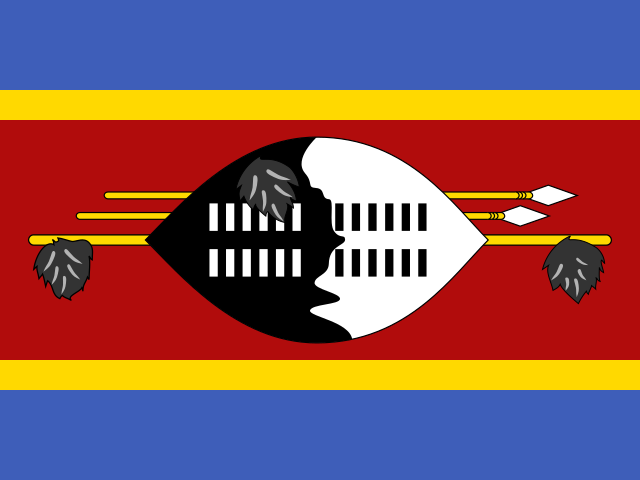
Eswatini runs to extremes in both directions. **Unemployment at 34.2 percent is the highest in this guide**, youth unemployment at 54.33 is third highest, and the Gini coefficient of 54.6 is the third highest figure — though it dates from 2016 and is flagged as stale. And at the same time **natural threats here are almost absent**: overall hazard is 1.8 out of 10 on INFORM, the seventh lowest among 168 countries — there is no sea, so no coastal hazard and no tsunami at all, earthquakes are 0.1, flooding 1.8, cyclones 0.2, and only drought at 4.7 is appreciable. Life expectancy is 64.26 years, health spending 296.05 dollars per person per year, water access reaches 80.37 percent of the population, and PM2.5 stands at 16.75 micrograms per cubic metre. Homicides run at 13.68 per 100,000 and road deaths at 24.7. On the World Bank scale, control of corruption is −0.79, rule of law −0.86, government effectiveness −0.78 and political stability −0.73 — appreciably better than most of its neighbours in this part of the guide. A one-bedroom in Manzini rents for 134 euros a month, among the lowest in this guide. The immigration framework is described by three Ministry of Home Affairs documents, and the ministry publishes all three itself: the Act of 1982, the Regulations of 1987 and the service charter. The Act sets ten classes of entry permit, A to J, and nine of the "useful" classes carry the condition "of benefit to the country" written into their very definition. The employer must confirm that the vacancy was advertised at full page, and during the assessment the localization department checks that the skill is not available inside the country. The charter prints the standard step by step: up to thirty minutes to lodge the documents, up to three days for vetting by the police and the localization department, one day for the committee, one day to issue the outcome — about five days for a temporary permit. For a visa: five minutes to receive it, two days for police vetting, one day for approval. Settlement is class J, and the road to it is unusual: ten years of continuous residence AND a completed "Khonta" under Swazi customary law — the act of pledging allegiance to a chief — AND proof that the person applied for citizenship and was not refused. A class J holder, like the class I person of independent means, loses the permit on taking up any employment, paid or unpaid. Family runs through the dependant's pass, which a citizen of the country may also request; the pass expires thirty days after the dependant takes up employment. What is not in this data: the processing time for a citizenship application — the charter states outright that the Citizenship Board determines it after going through each application. The procedure for bringing in cats and dogs is described neither by a national source nor by other countries' veterinary authorities. City populations are not given: no official source separating the city from the region could be found.
Tanzania in brief
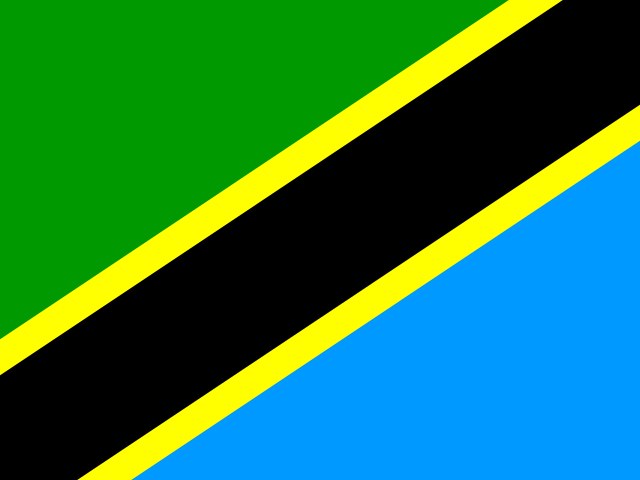
Tanzania splits the right to reside in the country and the right to work between two authorities: the Immigration Service issues residence permits in three classes (A — investors and the self-employed, B — employees under a specific job offer, C — other grounds) under the Immigration Act, 1995, while the Labour Commissioner under the ministry responsible for employment issues a separate work permit in one of five classes (A–E, for investors, holders of in-demand professions, other professions, religious/charitable activity, and refugees) under the Non-Citizens (Employment Regulation) Act, 2015; legal paid employment requires both documents at once. Residence permits are capped by default at five years total (three years plus a renewal of up to two), and no separate permanent-residence status has been established between this term and citizenship — the only exception found covers a narrow category of major investors after 10 years of residence. Naturalisation requires practically 8 years of residence (the year immediately before filing plus at least 7 of the preceding 10 years), knowledge of Swahili or English, and renunciation of prior citizenship: dual citizenship is not permitted by law. Zanzibar is an autonomous part of the Union Republic: the law explicitly provides for additional entry and residence rules there, set with the consent of the President of Zanzibar, separate from the mainland's. The guide's five cities reflect both the largest population centres (Dar es Salaam — the country's commercial and technology centre, Mwanza — the second-largest city on Lake Victoria), the official capital, Dodoma, and two key inbound tourism destinations — Arusha (the gateway to the Serengeti and Kilimanjaro) and Zanzibar City with Stone Town, a UNESCO World Heritage Site.
Other comparisons
Eswatini or… Nigeria · Rwanda · Tunisia · Algeria · Kenya · South Africa · Angola · Gabon
Tanzania or… Madagascar · Sierra Leone · Uganda · Zambia · Lesotho · Mozambique · Republic of the Congo · Burundi
More on each: Eswatini · Tanzania. Build your own comparison — up to four countries
This material is for reference and is not legal, tax or immigration advice. Visa rules, tax thresholds and prices change. Before deciding anything, check the official sources and consult a licensed professional in the relevant country.