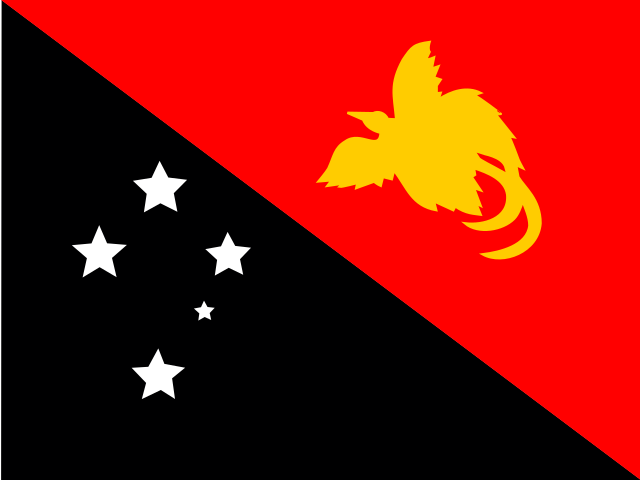
Papua New Guinea
Papua New Guinea · Oceania · updated 24.08.2026
Papua New Guinea carries one of the highest seismic risks in this set and the lowest access to water. On INFORM its overall natural risk is 6.0 out of 10, of which earthquakes 9.2, tsunami 7.1, coastal risks 6.3 and floods 4.6. Basic access to water covers 53.3 per cent of the population, lower than in any other country in this guide. Life expectancy is 66.26 years and health spending 85.15 dollars per person per year. The air, by contrast, is clean: mean PM2.5 concentration is 14.11 micrograms per cubic metre. On the World Bank scale from −2.5 to +2.5, government effectiveness stands at −0.90, control of corruption at −0.80, political stability at −0.65 and rule of law at −0.57. Road deaths run at 14.9 per 100,000; the homicide data is old, 9.34 per 100,000 for 2010. The unemployment figures — 2.57 per cent overall and 3.79 among young people — reflect the structure of a labour market that is almost entirely informal and subsistence-based, not the absence of a problem finding work. The immigration framework is unusual in the balance of what it publishes. Visa categories are described in words but almost never in numbers: the authority makes the validity of a visa depend on the applicant's circumstances and invites enquiries for details. Only the maximum lengths of stay are published — 60 days on the visitor visa and 30 on the business visa, both single entry. The work permit and the work visa, meanwhile, are brought into a SINGLE application lodged by the employer through the sponsor portal rather than by the worker. Permanent residence, by contrast, is set out in detail and with figures: seven classes — chief executive of a large company, business owner, doctor or educationist, missionary, retiree over 55, spouse of a citizen, adult child of a citizen doing voluntary work — and in all seven the qualifying period is the same, five years; what differs are the income and asset thresholds. What this data does not contain, and why: the authority publishes no processing standards for any category. Importing cats and dogs is difficult not because of vaccinations but because of the route: an import permit from the Chief Stock Inspector is mandatory, and the import goes via Australia with quarantine there, whose duration is set by the Australian side. City populations are not given: no official source separating city from province could be found.
Some descriptions for this country are still Russian only: 62% translated. Numbers, prices and timelines are complete.
Entry
Entry rules depend on citizenship. Choose a passport to see the requirement for that one.
Work and visas
- Visa speed
- The department publishes NO processing standard anywhere. The wording is the same on the page of every visa category: the validity of the visa depends on the applicant's individual circumstances, and for details you are invited to contact ICA. There is not a single figure about the decision time on any of the forty class cards, nor in the tariff sheet. The one thing the department sells instead of a deadline is a PLACE IN THE QUEUE. Priority processing costs 2,000 US dollars and is available for every visa class EXCEPT permanent residence and change of status. How many days that sum saves is not stated: what is sold is priority, not a term. What is published instead of processing times are maximum periods of STAY, and only for three classes out of forty: the visitor visa — 60 days single entry from the date of arrival; the Restricted Employment Visa — no more than four entries in twelve months, each stay no longer than thirty days; the visa for a dependent of a citizen with no work rights — multiple entry for five years. An extension inside the country is possible, but the department makes those conditions depend on circumstances too. There are two firm rules here, and both are restrictive: an extension application is lodged WELL IN ADVANCE, before the current permit expires, and only by someone who is IN THE COUNTRY — you cannot extend from abroad. And separately: “there is no period of grace in relation to extensions”. The price of being late is printed straight into the tariff — a late extension costs from 380 to 1,350 dollars against an ordinary extension of 75 to 700 — while overstaying the permitted stay is punished on a ladder: nothing up to 28 days, 3,000 kina for 29–60 days, 5,000 kina for 61–365 days, 10,000 kina from a year onwards, possibly with prosecution. Payment goes through the department's own gateway: create a MICA account on `ica.gov.pg`, pay for one or more services, print the receipt and lodge the application TOGETHER with it. That is a payment procedure, not an application one. Papua New Guinea's overseas missions no longer accept cash, and nothing paid is refunded. There is one exception: the employer pays for the employment visa and the work permit together, at the moment of lodgment through the sponsor portal, and the department warns separately NOT to pay for that through MICA.
Visa types: Visitor visa — holidays, sightseeing, social and recreational purposes, visiting relatives and friends. The applicant must show they are a genuine tourist and intend to leave at the end of their stay. In most cases it is issued for a single entry with a stay of **60 days** from the date of arrival. Within the category there are separate classes: visitor proper, sportsperson, and non-commercial film-maker. · Business visa — for a genuine business person or someone engaged in approved employment, intending to leave at the end of their stay. In most cases a single entry with a stay of **30 days** from the date of arrival. The APEC Business Travel Card scheme operates separately. · Employment visa — mandatory for anyone intending to take up paid work, including some already living in the country. **The key feature of the procedure: the employer applies for the work permit TOGETHER with the visa — through the ICSA sponsor portal or at the authority's office.** These used to be two separate procedures. The authority makes the requirements and the validity depend on the applicant's circumstances and publishes no single figures. · Special Exemption visa — for educational, medical and scientific research; teaching at an institution in the country; providing emergency relief after a natural or national disaster; and for domestic staff of foreign diplomats living in the country. · Journalist visa — a separate category for press work. · Visa on arrival — available to citizens of countries on a separate list and issued through the electronic visa portal. Everyone else applies on the paper form "Application for Entry Permit".
Collected on 24 August 2026 from the site of the Immigration and Citizenship Authority (`ica.gov.pg`) and from its tariff sheet “Revised Migration Service Fees” — the only document of the department where the visa classes are listed in full and with figures. **The real classifier of visas is not in the visa section but in the tariff.** The site describes twelve classes; the tariff sheet has FORTY. Only there do Consultant/Specialist, Business Person or Investor, Working Dependent, Dependent of Citizen (Working) exist, along with every entertainer class except non-commercial filming (comedian, musician, gospel and cultural groups, commercial filming), Research Academic, Religious Worker, Emergency Relief Worker, Medical Workers, Domestic Worker, Aid Worker/Volunteer and a line of its own for volunteers of Youth With A Mission. The visa section of the site is a shop window; the tariff is the register. **The tariff is a table in a PDF, and two modes of one extractor read it differently.** `pdftotext -layout` put “no fee” on the journalist row; `pdftotext -table` put 350 dollars. The columns were reconstructed from the COORDINATES of the words (PyMuPDF): every figure has its own vertical — 246 for the fee, 287 for the extension, 338 for the late extension, 380 for the eVisa. The table layout turned out to be the right one. Everything recorded here has been checked against coordinates, not against alignment by spaces. **Four prices for every class, and the third one is a penalty.** The department prints a visa fee, an extension fee, a LATE extension fee and an eVisa fee. Lateness costs several times more: 380, 700, 1,000, 1,050 or 1,350 dollars against extensions of 75, 150, 200, 500 or 700. Lateness is most expensive for the employment classes — 1,350 against 700. **Since 1 November 2019 visa fees are levied in US DOLLARS.** So established by National Gazette No. 231 of 27 March 2019 (Migration Fees (Amendment) 2019); the tariff sheet was published on 23 October 2019. The kina survives only where the matter is not a visa: permanent residence is named both in dollars (1,700) and in kina (5,780), re-evidencing the permit in a new passport costs 255 kina, and citizenship, passports and overstay penalties are counted in kina alone. Nothing paid is refunded, and overseas missions no longer take cash. **The overstay penalty rises in steps and starts at zero.** Up to 28 days — nothing; 29–60 days — 3,000 kina; 61–365 days — 5,000 kina; from a year — 10,000 kina “and may also involve prosecution”. It does not touch those covered by Aid Status and by the Vienna Convention. **Speeding up costs more than any visa in the country: 2,000 dollars.** Available to every class EXCEPT permanent residence and change of status. **A change of status inside the country has a tariff of its own and very narrow grounds.** 500 dollars — for a legally dependent spouse with teaching, medical or other essential professional skill; 1,000 dollars — for someone who has completed (or is deemed to have completed) their commitments to an employer and found another, excluding those employed under the Employment of Non-Citizens Act 2000; 700 dollars — on a change of marital status while in the country; and another 700 — for someone affected by a legal change to the name and constitution of the employing organisation. **The work permit and the employment visa are ONE application, and the employer lodges it.** It goes through the sponsor portal: the employer files the application, pays the work permit fee together with the migration service fee, and does NOT pay separately through MICA. Everything begins on the hirer's side, not the mover's. The list of attachments includes a maintenance guarantee bond, an extract from the Investment Promotion Authority (IPA), the company structure, a signed employment contract, a police clearance certificate and a medical examination report. **Terms are almost never published.** Every class page says the visa is issued “subject to the individual circumstances of the traveller” and invites you to contact ICA. Figures exist for THREE classes out of forty: the visitor visa — 60 days single entry from the date of arrival; the Restricted Employment Visa — no more than four entries in twelve months, thirty days each; the visa for a dependent of a citizen with no work rights — multiple entry for five years. Everything else is empty, and that is not a gap in the collection but the department declining to name a term. **Permanent residence, by contrast, is spelled out with figures — in seven classes.** A chief executive of a company with a workforce of 250 or more and an annual turnover of 10 million kina or more, operating in the country for over five years. A majority owner of an investment in a registered local business for at least five years with net assets and turnover exceeding 2 million kina, or a property investment of at least 10 million kina. A medical doctor, specialist or educationist with tertiary qualifications in the field and five years of work in that field IN THE COUNTRY — the only class the department says outright is SUBJECT TO ANNUAL REVIEW. A missionary with five years of work and an income of at least 25,000 kina a year, or a written guarantee of support from a church — the only FREE class of permanent residence. A retired person over 55 with an income of at least 50,000 kina a year who has worked in the country for five years. The spouse of a citizen where the marriage has lasted at least five years. And the adult child of a citizen over 19 — but only if working VOLUNTARILY at a community or social level. **The million-scale thresholds are printed as WORDS, so there is no figure in the field.** “K10 million”, “K2 million” — the department writes the order of magnitude as a word rather than in digits; that does not go into a numeric field, and the condition is described in prose. Only 25,000 and 50,000 kina a year are printed in digits, and those are what has been recorded. **Permanent residence is granted for the life of the PASSPORT.** Not for a number of years: the permit lasts as long as the holder's current foreign passport and is re-evidenced in a new one for 255 kina. It is cancelled on a sentence of imprisonment longer than three months and when the holder stays outside the country for more than twelve continuous months without reasonable cause. The holder is exempt from the Employment of Non-citizens Act but may not hold public office or take part in politics. **A same-sex marriage is not a ground, and the department writes it plainly.** On the page about dependents of a permanent resident: the spouse must be over 18 “and cannot be of the same sex as the applicant”. Dependents must be included in the INITIAL application — they cannot be added later; employment is prohibited for them, though a permanent resident spouse may work in a family-run business. A child born to a permanent resident qualifies automatically — only 255 kina is paid for evidencing it in the child's passport. **The nationality rule is filled in on one ground.** The Melanesian Spearhead Group visa: Papua New Guinea is itself in the group, so the rule records the other member states — Fiji, the Solomon Islands and Vanuatu. A visa on arrival exists separately for citizens of a list of countries, but that is a way of getting a visitor permit, not a ground for living there. **What is not among the grounds.** The tourist visa in its two forms (on a tour package and on your own itinerary) and the Easy Visitor Permit for 30 and 60 days are permission to enter, not to live. The visa on arrival is a way of lodging. Citizenship is not a visa ground and is counted in kina: naturalisation (for a sportsperson, an investor, a long-term resident, by marriage) — 10,000 kina, naturalisation with dual citizenship — 15,000, by descent — 10,000. It is handled under a separate procedure.
Long-term visas and residence permits
Visitor — visiting relative
FamilyVisitor — yachtperson (crew)
OtherVisitor — yachtperson (owner or captain)
OtherJournalist / Reporter visa
WorkBusiness Short-term Multiple Entry
OtherBusiness (short term, single entry)
OtherRestricted Employment Visa
WorkWorking Resident — employment
WorkWorking Resident — consultant or specialist
WorkWorking Resident — short term employment
WorkWorking Resident — business person or investor
InvestmentWorking Resident — working dependent
FamilyWorking Resident — dependent of a citizen (working)
FamilyWorking Resident — dependent
FamilyEntertainer — film-maker (commercial)
OtherEntertainer — film-maker (non-commercial)
OtherEntertainer — comedian (commercial)
OtherEntertainer — musician (commercial)
OtherEntertainer — gospel group (charity)
OtherEntertainer — cultural group (charity)
OtherStudent — formal education
StudyOccupational Trainee visa
StudyStudent — dependent
FamilySpecial Exemption — foreign official (long term)
OtherSpecial Exemption — foreign official (short term)
OtherSpecial Exemption — diplomats
OtherSpecial Exemption — aid worker or volunteer
OtherSpecial Exemption — aid worker / volunteer (YWAM)
OtherSpecial Exemption — research academic
OtherSpecial Exemption — sportsperson
OtherSpecial Exemption — religious worker
OtherSpecial Exemption — emergency relief worker
OtherSpecial Exemption — medical workers
WorkSpecial Exemption — Melanesian Spearhead Group
OtherSpecial Exemption — domestic worker of an accredited diplomat
WorkSpecial Exemption — dependents of diplomats and international bodies
FamilyDependent of a PNG citizen (non-working)
FamilyPermanent Residence — chief executive of a large company
OtherPermanent Residence — majority owner of a business investment
InvestmentPermanent Residence — skilled professional
TalentPermanent Residence — missionary or religious worker
OtherPermanent Residence — retired person over 55
RetirementPermanent Residence — spouse of a citizen
FamilyPermanent Residence — adult child of a citizen
FamilyPermanent Residence — dependents (long term)
FamilyProgramme terms change, and the final decision rests with the consulate or the country migration service. The data is collected from official sources on the date shown and is not legal advice.
Residence and citizenship
- Permanent residence after
- 5 years
Permanent residence is set out by the authority in seven classes, and in ALL seven the qualifying period is the same — five years; only the grounds differ. First: chief executive of a large company with a workforce of 250 or more and an annual turnover of 10 million kina or more, where the company must have been operating in the country for more than five years. Second: majority owner of a business in a registered local company for at least five years with net assets and turnover exceeding 2 million kina, or property investment with a net investment in the country of at least 10 million kina. Third: a skilled professional — a medical doctor, specialist or educationist — with tertiary qualifications and at least five years working in that field in the country; this class is reviewed annually. Fourth: missionaries and religious workers who have worked in the country for at least five years, with an income of no less than 25,000 kina a year or a written guarantee of support from a registered religious organisation. Fifth: a retiree over 55 with an income of at least 50,000 kina a year who has worked in the country for at least five years. Sixth: the lawful spouse of a citizen where the relationship has been in place for at least five years. Seventh: a citizen's child over 19 without citizenship of the country, provided they are engaged in voluntary work at community or social level. Every ground requires certified documentary evidence. The source is the "Permanent Residence Classes" section of the Immigration and Citizenship Authority (ica.gov.pg), read on 07.08.2026.
Documents
- Document certification
- consular legalisation
The country does not accept apostilles: documents go through consular legalisation in three steps — ministry of justice, foreign ministry, consulate.
Family
Partner
Parents
Partner's parents
Pets
- Limit
- no limit
- Antibody titre test
- not needed
- Preparation
- ~1 months
The strictest procedure of any country in this group, and the difficulty is not in the vaccinations. First, an import permit from the Chief Stock Inspector of Papua New Guinea is MANDATORY. Second, the guidance note states the route outright: import goes VIA AUSTRALIA, where the animal undergoes quarantine. Quarantine therefore exists, but it is Australian and in transit, not on arrival in the destination country — which is why the field is left empty rather than set to zero: the duration is set by a third party, and this document does not give it. Vaccinations: dogs against distemper, viral hepatitis and parvovirus no less than 7 days and no more than a year before export; cats against panleukopenia over the same interval. Dogs only additionally require praziquantel treatment within 14 days before export. A separate attestation covers the absence of contact with diseased animals during the previous 30 days. The certificate is valid for seven days. Antibody titration and banned breeds are not mentioned in the document. No source of the country's own on importing cats and dogs could be found, so the requirements are read from a document issued on the other side of the border, with explicit attribution: the British export health certificate (DEFRA/APHA) — a description of the receiving side's requirements drawn up for export from the United Kingdom. Some of its conditions relate to the United Kingdom itself (the animal's residence there before export, the country's status as free of rabies) and are replaced, when leaving another country, by that country's own equivalents; the values set by the receiving side, however, do not depend on the country of departure. Read on 07.08.2026.
Safety
Climate
Quality of life
Cities
Port Moresby
The capital and main port on the southern coast; here are the Immigration and Citizenship Authority, through which visas and permanent residence pass, and the country's main international airport.
The country lies on a plate boundary, and the seismic risk here is among the highest in this set — 9.2 out of 10 on INFORM, with tsunami at 7.1 and coastal risks at 6.3. Separately from nature: basic access to water nationally covers just 53.3 per cent of the population, the lowest figure among the countries in this guide.
Lae
The country's second city and its main cargo port on the northern coast, at the start of the Highlands Highway — the main road into the interior. Prices are virtually indistinguishable from the capital's.
The same high seismicity and the same tsunami risk as across the country. The city stands at the mouth of the Markham River, so flooding is added to the seismicity — the national figure is 4.6 out of 10.
Grocery basket
- Bread, 500 g
- $ 0,81
- Milk, 1 l
- $ 1,22
- Eggs, 12
- $ 1,76
- Chicken breast, 1 kg
- $ 4,52
- Cheese, 1 kg
- $ 7,43
- Rice, 1 kg
- $ 1,20
- Potatoes, 1 kg
- $ 1,05
- Apples, 1 kg
- $ 2,34
- Coca-Cola / Pepsi, 2 l
- $ 1,26
- Total
- $ 21,6
The same set for every country, so the comparison is fair.
Cost of living across the country
- Rent, 1 bedroom
- $ 228 a month
- Rent, 3 bedrooms
- $ 481 a month
- Utility bills
- $ 64,6 a month
- Home internet
- $ 24,5 a month
- Monthly transport pass
- $ 17,6 a month
- Single transport ticket
- $ 0,43
- Petrol, litre
- $ 1,04
- Cold medicine
- $ 3,98 for a week
Country averages. City prices, where collected, are shown above and are more precise.
Indicators
- Life expectancy
- 66,3 years2024
- Homicides
- 9,3 per 100k2010 · data lags behind
- Road deaths
- 14,9 per 100k2021
- Unemployment
- 2,6 %2025
- Unemployment, ages 15–24
- 3,8 %2025
- Health spending per person
- $ 85,2 a year
- Air pollution, PM2.5
- 14,1 µg/m³2023
- Access to clean water
- 53,3 %2024
Governance
- Political stability
- below average · -0,7
- Control of corruption
- below average · -0,8
- Rule of law
- below average · -0,6
- Government effectiveness
- below average · -0,9
World Bank estimates on a −2.5 to +2.5 scale, higher is better.
Natural hazards
- Earthquakes
- 9,2 out of 10
- River floods
- 4,6 out of 10
- Coastal floods
- 6,3 out of 10
- Tropical cyclones
- 2,8 out of 10
- Droughts
- 2,5 out of 10
- Tsunamis
- 7,1 out of 10
Each value carries the year it refers to. “Data lags behind” means this country's figure was collected noticeably earlier than the rest. Natural hazards use one 0–10 scale and are meant to be compared against each other.
Compare with other countries in the region
Australia · Fiji · New Caledonia · New Zealand · Solomon Islands · Vanuatu