Some descriptions for this country are still Russian only: 90% translated. Numbers, prices and timelines are complete.
Nicaragua: cities, climate & safety
updated 19.11.2026
Cities
Managua
The capital and largest municipality of the country: 1,066,484 people per the INIDE 2024 estimate (Managua municipality, Managua department; Anuario Estadístico 2023, II.1.4). Nicaragua's administrative, business and transport centre, seat of the government and the country's main labour market.
The city lies in an area of active seismicity on the shore of Lake Xolotlán, crossed by faults: the earthquake of 23 December 1972 (magnitude about 6.3) almost completely destroyed the historic centre of the capital and killed several thousand people, which is why the modern business centre was built away from the old one. According to INETER/INIDE (Anuario Estadístico 2023, I.3.1), about 87% of the country's seismic events are concentrated near the Pacific coast, with a further roughly 10% along the volcanic chain (including Momotombo volcano on the far shore of Lake Managua/Xolotlán, within the department). There is also a hurricane season on the Caribbean coast (June–November), although the capital itself is on the Pacific side and is subject mainly to flash flooding from heavy rain rather than direct wind strikes.
León
The country's second most important colonial and university city, and a former capital of Nicaragua: 216,108 people per the INIDE 2024 estimate (León municipality, León department; Anuario Estadístico 2023, II.1.4). León Cathedral is a UNESCO World Heritage Site. Note: the City Centre row on livingcost.org gives a LOWER price for a three-bedroom apartment than for a one-bedroom one ($171 vs $362) — an atypical result, likely due to the site's small sample for this city; the figures are given as-is, without correction, but should be checked separately before use.
Part of León department, where the Nicaraguan volcanic chain lies: according to INETER/INIDE (Anuario Estadístico 2023, I.3.1), the San Cristóbal, El Hoyo, Cerro Negro and Momotombo volcanoes account for about 10% of the country's seismic activity. Cerro Negro is one of the youngest and most active volcanoes in Central America, with a history of eruptions in the 20th–21st centuries.
Masaya
A city of crafts, known for its market (Mercado Viejo) and its proximity to the active volcano of the same name: 196,798 people per the INIDE 2024 estimate (Masaya municipality, Masaya department; Anuario Estadístico 2023, II.1.4).
Within the department lies the active Masaya volcano (Volcán Masaya) with a permanently visible lava lake in its crater — one of the most active volcanoes in Nicaragua, periodically producing emissions of volcanic gas and ash that affect nearby settlements. Also nearby is the volcanic Laguna de Apoyo, which the department shares with Granada.
Granada
The country's leading tourist destination — the oldest Spanish colonial city on the American continent, on the shore of Lake Nicaragua (Cocibolca): 136,157 people per the INIDE 2024 estimate (Granada municipality, Granada department; Anuario Estadístico 2023, II.1.4).
Mombacho volcano lies near the city — geologically classed as dormant, but with a history of large slope collapses (including a historic collapse that destroyed several villages at its foot); the volcano's slopes are prone to landslides in the rainy season. The department also includes part of the volcanic Laguna de Apoyo, which it shares with Masaya.
San Juan del Sur
The main beach resort of the Pacific coast, a surfing centre and yacht harbour: 16,123 people per the INIDE 2024 estimate (San Juan del Sur municipality, Rivas department; Anuario Estadístico 2023, II.1.4).
According to INETER/INIDE (Anuario Estadístico 2023, I.3.1), "Frente a San Juan del Sur" is one of the THREE zones of maximum concentration of the country's seismic activity in the Pacific subduction zone (alongside Cosigüina-Corinto and Puerto Sandino-Masachapa-La Boquita) — that is, the official source names the city directly among the most seismically active points on the coast.
Climate
Safety
- Situation
- advisories in place
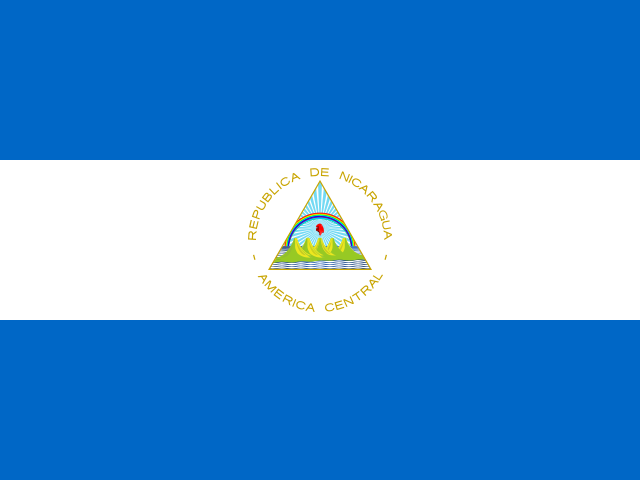
A number of countries issue heightened-caution official travel advisories for Nicaragua. Per independent confirmation from the UK government (gov.uk/foreign-travel-advice/nicaragua/safety-and-security, updated 10.12.2025): "foreign nationals are banned from taking part in any political activity in Nicaragua" — including participating in protests and using the country's national colours (blue and white) for the purposes of campaigning or protest, on pain of arrest, detention or deportation. This is a direct consequence of the general rule in art. 13 of the Ley General de Migración y Extranjería (Ley No. 761): a foreigner is prohibited from any activity outside what is expressly permitted by their visa category, on pain of losing residency and being expelled. Separately, since December 2024, Law No. 1230 has been in force, requiring persons who own unmanned aerial vehicles (drones) to surrender them to the authorities (same gov.uk source).
Natural hazards
According to INETER (Instituto Nicaragüense de Estudios Territoriales), as cited in INIDE, Anuario Estadístico 2023, section I.3.1: about 87% of the country's seismic events are concentrated in the Pacific subduction zone (three named segments: Cosigüina-Corinto, Puerto Sandino-Masachapa-La Boquita and San Juan del Sur), with a further roughly 10% along the volcanic chain (San Cristóbal, El Hoyo, Cerro Negro, Momotombo); the INETER network recorded 2,414 earthquakes on Nicaraguan territory in 2022.
The hurricane season on the country's Caribbean coast runs June–November. The risk is unevenly distributed across the territory: the Caribbean regions (RACCN, RACCS), including Puerto Cabezas/Bilwi, are hit directly by hurricanes far more often than the Pacific-side cities studied here (Managua, León, Masaya, Granada, San Juan del Sur).
The country lies in the Central American Pacific volcanic chain, with several active volcanoes near major cities: Masaya (Volcán Masaya, active, with a permanently visible lava lake, near the city of Masaya), Momotombo and Cerro Negro (near León, León department), Mombacho (near Granada, with a history of slope instability). Per INETER/INIDE (Anuario Estadístico 2023, I.3.1), the volcanic chain accounts for about 10% of the country's seismic activity.
The country lies in the Pacific volcanic belt with high seismic and volcanic activity (INETER/INIDE) and shares with neighbouring Central American countries a hurricane season on the Caribbean coast (June–November), while Pacific-side cities are noticeably less exposed to hurricanes than Caribbean ones.
Travel services: Nicaragua
Ad · Aviasales, GetRentacar, AiraloCompare flight prices across airlines and travel agencies.
Local rental companies and private owners, no-deposit options.
Digital travel eSIM plans without roaming fees or physical SIM cards.