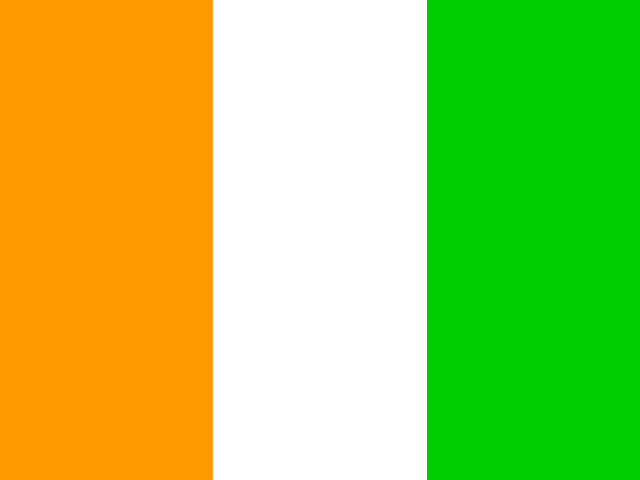
Some descriptions for this country are still Russian only: 83% translated. Numbers, prices and timelines are complete.
Cote d'Ivoire: cities, climate & safety
updated 19.11.2026
Cities
Abidjan
tech hubThe country's economic capital and West Africa's largest city, on the coast of the Gulf of Guinea. Côte d'Ivoire's official capital under the Constitution is Yamoussoukro, but the government, ministries and almost all foreign embassies are in practice located in Abidjan. Population — 5,616,633 at the RGPH 2021 census (Institut National de la Statistique, report "RGPH-2021 Résultats globaux," plateau.gouv.ci): this is the sum of the city proper's (Ville d'Abidjan) 10 urban communes, excluding the neighbouring communes of Anyama, Bingerville, Brofodoumé and Songon — together with them, the Autonomous District of Abidjan reaches 6,321,017 people, but this broader unit is not used here.
A coastal city on a lagoon: countrywide flood risk per INFORM is 4.8/10, coastal-zone risk is 2.1/10, earthquake risk is minimal (0.1/10). Dense development around the Ébrié Lagoon causes localised flooding during the rainy season (June–July).
Yamoussoukro
The official capital of Côte d'Ivoire under the 2016 Constitution (art. 48 of the constitutional text does not name the city directly; the status is fixed by separate acts and by practice dating from 1983), the hometown of the first president, Félix Houphouët-Boigny. In practice, however, the government and most embassies operate in Abidjan — Yamoussoukro remains the official but not the functioning capital. The commune's population was 340,234 at the RGPH 2021 census (INS, "RGPH-2021 Résultats globaux"); excluding the rural suburb of Kossou (32,326) and the neighbouring department of Attiégouakro.
A landlocked city: the countrywide flood risk is moderate (4.8/10 on INFORM), earthquake risk is minimal (0.1/10); no city-specific risks were identified in the sources.
Bouaké
The country's second-largest city, in the central part of the country, the historic trading and textile centre of the Gbêkê region. The commune's population was 832,371 at the RGPH 2021 census (INS, "RGPH-2021 Résultats globaux"), excluding the other communes of the same-named department (Bounda, Brobo, Djébonoua, Mamini).
A landlocked city; countrywide flood and earthquake risk is below average (INFORM: floods 4.8/10, earthquakes 0.1/10). The city suffered severely during the 2002–2011 political crisis, when it was the de facto capital of the rebel-held north of the country — this episode affects perception rather than current physical risk.
Daloa
A major city in the west of the country, the centre of the Haut-Sassandra region and one of the main coffee and cocoa production centres in Côte d'Ivoire. The commune's population was 421,879 at the RGPH 2021 census (INS, "RGPH-2021 Résultats globaux"), excluding the other communes of the same-named department.
A landlocked city; countrywide flood risk (4.8/10) and earthquake risk (0.1/10 — minimal) per INFORM. No city-specific data found.
Grand-Bassam
The first colonial capital of Côte d'Ivoire (until 1900) and a beach resort 40 km from Abidjan. The historic quarter of the town (Ancien Grand-Bassam) was inscribed on the UNESCO World Heritage List in 2012 as an example of late-19th-century colonial trading and administrative architecture. The commune's population was 124,567 at the RGPH 2021 census (INS, "RGPH-2021 Résultats globaux"), excluding the neighbouring communes of Bongo and Bonoua within the same department.
A coastal city: countrywide coastal-zone risk per INFORM is 2.1/10, flood risk is 4.8/10, earthquake risk is minimal (0.1/10). Coastal erosion is a known problem along this stretch of the Ivorian coast.
Climate
Safety
Travel services: Cote d'Ivoire
Ad · Aviasales, GetRentacar, AiraloCompare flight prices across airlines and travel agencies.
Local rental companies and private owners, no-deposit options.
Digital travel eSIM plans without roaming fees or physical SIM cards.