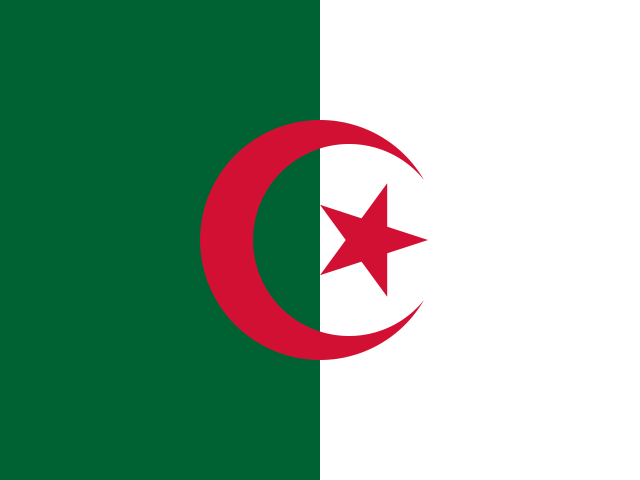
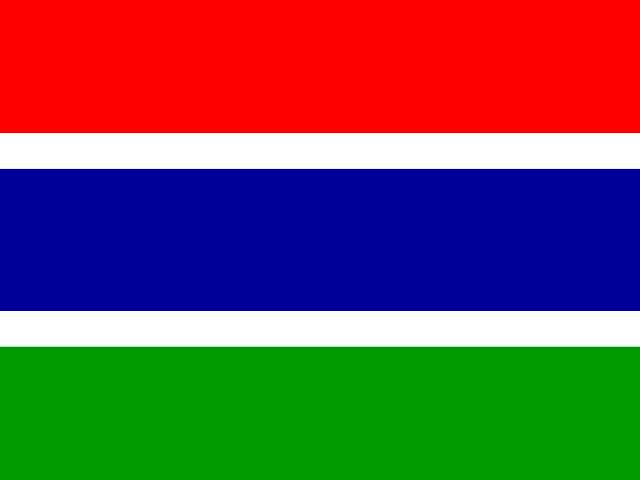
Algeria or The Gambia
Two countries side by side across the same rows as the full comparison. A dash means the value is missing: fields are not filled with guesses. about the data
| Algeria | The Gambia | |
|---|---|---|
| Salary in IT | — | — |
| Citizenship | 7 years | — |
| Partner can work | — | — |
| Parents | — | — |
| Pets | no trouble | difficult |
| Pet limit | no limit | no limit |
| Quarantine | no | — |
| Residence permit fee | — | — |
| Rent, 2 bedrooms | $ 209 · estimate | $ 122 · estimate |
| Basket | $ 21,4 | $ 19,2 |
| Life expectancy | 76.47 | 66.06 |
| Homicides/100k | 1.38 | — |
| Natural hazards, 0–10 | 3.4 | 2.9 |
How the two sets of routes differ
Long-stay routes in this reference: Algeria — 28, The Gambia — 6. Types present in both: work. Algeria adds: study and family.
Fees, thresholds and deadlines
Algeria: fees range from 1,000 to 70,000 DZD. Routes with a published decision deadline: 3; the shortest is 2 days. The Gambia: fees range from 100 to 7,700 GMD.
Beyond the first permit
Permanent status: Algeria after 7 years; the other country publishes no term. Citizenship: Algeria after 7 years; the other country publishes no term.
Algeria in brief
Algeria combines high seismicity and very high youth unemployment with cheap transport and fuel. On the World Bank scale from −2.5 to +2.5, political stability stands at −0.69, rule of law at −0.70, control of corruption at −0.59 and government effectiveness at −0.25 — governance scores noticeably better than most of the region. Life expectancy is 76.47 years, health spending 233.38 dollars per person per year, basic access to water reaches 92.42 per cent of the population, and mean PM2.5 concentration is 16.54 micrograms per cubic metre. Homicides at 1.38 per 100,000 are among the lowest figures in this set; road deaths run at 18.3. Unemployment is 11.63 per cent and among young people 29.44 — that is the defining feature of the labour market. Overall natural risk is 3.4 out of 10 on INFORM, and it is almost entirely seismic: earthquakes 7.9, floods 3.6, droughts 3.4, against coastal risks at 0.7, tsunami at 1.4 and no cyclones at all. Transport and fuel are cheap even by regional standards: a monthly pass costs 8.15 dollars and a litre of fuel 0.32. The immigration framework is published in full by Law No. 08-11 of 25 June 2008 in the official gazette, and it rests on a separation of three rights. Entry is granted by the consular visa: it is valid for up to two years, but the stay permitted on each entry is no more than 90 days. Residence is permitted by the resident card issued by the wilaya of residence, ordinarily for two years; after seven years of continuous lawful residence a ten-year card may be issued, and the same card goes to the resident's children over 18 living with them. Work is permitted by a separate document: a resident card is not issued to a salaried worker at all without a work permit, a temporary work authorisation or a declaration of employment, and the card cannot outlast that document. A thread running through the law is the principle of reciprocity: it is stipulated for consular fees, for appealing a refusal and for the age threshold alike. What this data does not contain, and why: the law expressly delegates to secondary legislation the procedure for issuing visas, the procedure for issuing the resident card and the conditions for family reunification — so no processing targets and no family timeline are to be found in it. City populations are not given: no official source separating city from wilaya could be found.
The Gambia in brief
The Gambia is very cheap and very poor at the same time. **A monthly transit pass at 6.55 dollars is the cheapest in this guide**, and a one-bedroom in Banjul rents for 80 euros with utilities at 26. And alongside that: health spending of 25.74 dollars per person per year — fifth from the bottom among 167 countries. Life expectancy is 66.06 years, basic water access reaches 87.1 percent of the population, PM2.5 stands at 38.27 micrograms per cubic metre (the twenty-fourth highest of 170), and road deaths run at 22.0 per 100,000. Unemployment is 6.52 percent, and 10.86 among young people. Overall natural hazard is 2.9 out of 10 on INFORM and almost entirely water-borne: flooding 4.6, drought 3.0, coastal hazards 2.5, tsunami 1.1, with earthquakes and cyclones practically absent. On the World Bank scale the governance figures are appreciably better than the regional norm: political stability −0.02, control of corruption −0.33, rule of law −0.39 and government effectiveness −0.54. The Immigration Department sets out the procedure in detail. A visa may be single journey, multiple journey (valid no longer than 12 months), transit, diplomatic (heads of missions only, and free) or short visit for 90 days; ECOWAS citizens need no visa. The service states twice that issuing a visa does not guarantee entry: the final decision rests with the officer at the port of arrival. There are two classes of residence permit: A — to live without gainful employment (students, retirees, short business visits) — and B, to live and work. The distinction by nationality runs through everything: an ECOWAS citizen obtains a permit after up to 90 days in the country, while a non-ECOWAS citizen must reside for up to 56 days after admission before a permit can be issued at all, and additionally receives an Alien Card. Fees run from 3,100 to 7,700 dalasi. Hiring is bounded by a QUOTA rather than a procedure: 80 percent of a workforce must be Gambians and 20 percent foreigners with skills unavailable in the country, and the Ministry of Trade administers it. Working without a residence and work permit is an offence. Family is arranged without a document of its own: the children and direct dependants of a permit holder are covered by that same permit, but on reaching adulthood must obtain one of their own. What is not in this data: there is no permanent residence in the department's catalogue, but a catalogue is not a law, and the Immigration Act itself is not published, so the number of years to permanent residence is left empty. The department publishes no processing standard for any of the seven steps of its own "processing cycle". The road to citizenship, by contrast, is published and long: seven years of residence from the date of marriage, or fifteen years by naturalisation. For cats there is no data at all — the British veterinary certificate for The Gambia covers only dogs. The city's population is not given: no official source separating Banjul from its area could be found.
Other comparisons
Algeria or… Nigeria · Rwanda · Tunisia · Tanzania · Kenya · South Africa · Angola · Gabon
The Gambia or… Madagascar · Sierra Leone · Uganda · Zambia · Eswatini · Lesotho · Mozambique · Republic of the Congo
More on each: Algeria · The Gambia. Build your own comparison — up to four countries
This material is for reference and is not legal, tax or immigration advice. Visa rules, tax thresholds and prices change. Before deciding anything, check the official sources and consult a licensed professional in the relevant country.