Algeria or Rwanda
Two countries side by side across the same rows as the full comparison. A dash means the value is missing: fields are not filled with guesses. about the data
| Algeria | Rwanda | |
|---|---|---|
| Salary in IT | — | — |
| Citizenship | 7 years | 15 years |
| Partner can work | — | — |
| Parents | — | — |
| Pets | no trouble | — |
| Pet limit | no limit | no limit |
| Quarantine | no | — |
| Residence permit fee | — | — |
| Rent, 2 bedrooms | $ 209 · estimate | $ 811 · estimate |
| Basket | $ 21,4 | $ 18,1 |
| Life expectancy | 76.47 | 68.02 |
| Homicides/100k | 1.38 | 3.61 |
| Natural hazards, 0–10 | 3.4 | 2.8 |
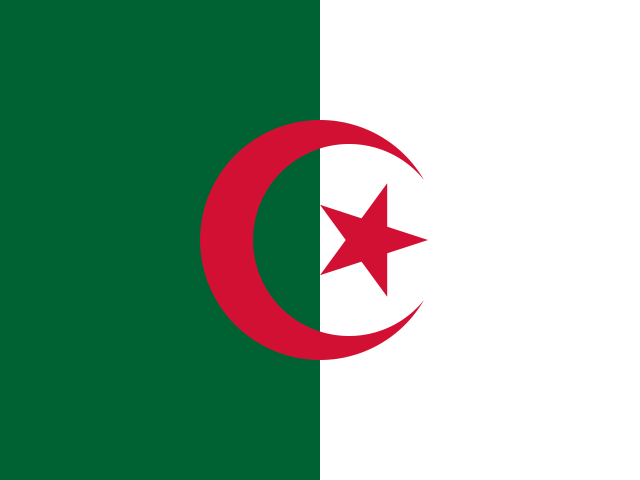
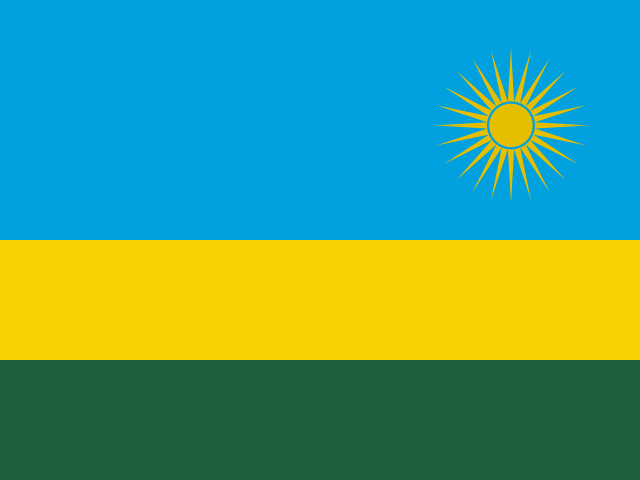
How the two sets of routes differ
Long-stay routes in this reference: Algeria — 28, Rwanda — 44. Types present in both: work, study and family. Rwanda adds: investment, talent, repatriation, retirement and job seeking.
Fees, thresholds and deadlines
Algeria: fees range from 1,000 to 70,000 DZD. Routes with a published decision deadline: 3; the shortest is 2 days. Rwanda: fees range from 20,000 to 250,000 RWF. Routes with a published decision deadline: 37; the shortest is 10 days.
Beyond the first permit
Permanent status: Algeria after 7 years, Rwanda after 10 years. Citizenship: Algeria after 7 years, Rwanda after 15 years. Both allow a second citizenship.
Algeria in brief
Algeria combines high seismicity and very high youth unemployment with cheap transport and fuel. On the World Bank scale from −2.5 to +2.5, political stability stands at −0.69, rule of law at −0.70, control of corruption at −0.59 and government effectiveness at −0.25 — governance scores noticeably better than most of the region. Life expectancy is 76.47 years, health spending 233.38 dollars per person per year, basic access to water reaches 92.42 per cent of the population, and mean PM2.5 concentration is 16.54 micrograms per cubic metre. Homicides at 1.38 per 100,000 are among the lowest figures in this set; road deaths run at 18.3. Unemployment is 11.63 per cent and among young people 29.44 — that is the defining feature of the labour market. Overall natural risk is 3.4 out of 10 on INFORM, and it is almost entirely seismic: earthquakes 7.9, floods 3.6, droughts 3.4, against coastal risks at 0.7, tsunami at 1.4 and no cyclones at all. Transport and fuel are cheap even by regional standards: a monthly pass costs 8.15 dollars and a litre of fuel 0.32. The immigration framework is published in full by Law No. 08-11 of 25 June 2008 in the official gazette, and it rests on a separation of three rights. Entry is granted by the consular visa: it is valid for up to two years, but the stay permitted on each entry is no more than 90 days. Residence is permitted by the resident card issued by the wilaya of residence, ordinarily for two years; after seven years of continuous lawful residence a ten-year card may be issued, and the same card goes to the resident's children over 18 living with them. Work is permitted by a separate document: a resident card is not issued to a salaried worker at all without a work permit, a temporary work authorisation or a declaration of employment, and the card cannot outlast that document. A thread running through the law is the principle of reciprocity: it is stipulated for consular fees, for appealing a refusal and for the age threshold alike. What this data does not contain, and why: the law expressly delegates to secondary legislation the procedure for issuing visas, the procedure for issuing the resident card and the conditions for family reunification — so no processing targets and no family timeline are to be found in it. City populations are not given: no official source separating city from wilaya could be found.
Rwanda in brief
Rwanda is a landlocked East African country, a member of the East African Community (EAC) and the Economic Community of the Great Lakes Countries (CEPGL). Entry is by visa on arrival for citizens of any country; for citizens of EAC member states — visa-free for up to 6 months. The residence permit system is built on alphanumeric classes — from temporary employment, investment, and entrepreneurship permits to permanent residence after a cumulative 10 years of legal residence — and is administered through the Directorate General of Immigration and Emigration and the Irembo e-government portal. Citizenship is available on several grounds (residence of 15+ years, marriage of 5+ years, investment, special skills, and others) with a uniform 6-month processing time; dual citizenship is permitted by law subject to declaration. Business and technology activity is concentrated in the capital, Kigali, while inbound tourism is directed toward the national parks — Volcanoes (mountain gorilla trekking) and Nyungwe (chimpanzees) — as well as Lake Kivu.
Other comparisons
Algeria or… Nigeria · Tunisia · Tanzania · Kenya · South Africa · Angola · Gabon · Madagascar
Rwanda or… Sierra Leone · Uganda · Zambia · Eswatini · Lesotho · Mozambique · Republic of the Congo · Burundi
More on each: Algeria · Rwanda. Build your own comparison — up to four countries
This material is for reference and is not legal, tax or immigration advice. Visa rules, tax thresholds and prices change. Before deciding anything, check the official sources and consult a licensed professional in the relevant country.