Dominican Republic or Nicaragua
Two countries side by side across the same rows as the full comparison. A dash means the value is missing: fields are not filled with guesses. about the data
| Dominican Republic | Nicaragua | |
|---|---|---|
| Salary in IT | — | — |
| Citizenship | 2 years | 4 years |
| Partner can work | yes | yes |
| Parents | — | doable |
| Pets | no trouble | no trouble |
| Pet limit | no limit | no limit |
| Quarantine | no | no |
| Residence permit fee | — | — |
| Rent, 2 bedrooms | $ 815 · estimate | $ 312 · estimate |
| Basket | $ 24,5 | $ 32,1 |
| Life expectancy | 73.87 | 75.1 |
| Homicides/100k | 9.12 | 5.45 |
| Natural hazards, 0–10 | 6.8 | 5.8 |
How the two sets of routes differ
Long-stay routes in this reference: Dominican Republic — 16, Nicaragua — 25. Types present in both: work, study, family, investment and retirement. The set of types is identical — the difference is in how many routes there are and on what terms, not in the types themselves.
Fees, thresholds and deadlines
Dominican Republic: fees range from 7,000 to 42,000 DOP. Routes stating an income threshold: 5; the lowest is 1,500 USD a month. Routes with a published decision deadline: 15; the shortest is 7 days. Nicaragua: fees range from 25 to 500 USD. Routes stating an income threshold: 2; the lowest is 1,000 USD a month. Routes with a published decision deadline: 24; the shortest is 30 days.
Beyond the first permit
Permanent status: Dominican Republic after 5 years, Nicaragua after 3 years. Citizenship: Dominican Republic after 2 years, Nicaragua after 4 years. Dominican Republic allows a second citizenship, Nicaragua does not.
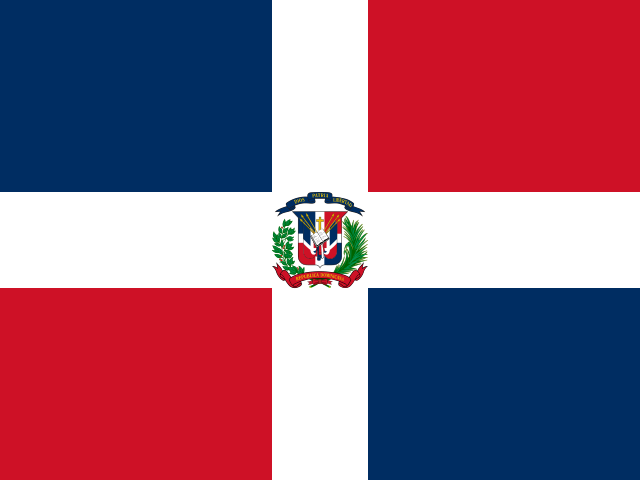
Dominican Republic in brief
The Dominican Republic is built around a resort economy: direct flights to North America and Europe, and the country's busiest airport is in Punta Cana, not the capital. Residence by investment, pension or rentier income is granted directly in permanent status, bypassing the five-year temporary-residence step required for other grounds; two years then remain before citizenship. Dual citizenship is permitted by the constitution, with no requirement to renounce the previous one. The entire territory lies in the tropical-cyclone zone (season June–November, the maximum risk score on the INFORM scale) and in a seismically active part of the Caribbean basin.
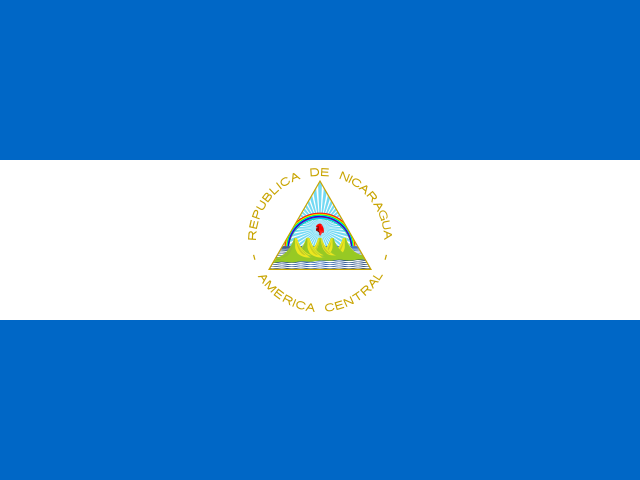
Nicaragua in brief
The Ley General de Migración y Extranjería (Ley No. 761, consolidated text as of 18.01.2024) divides foreigners into residents and non-residents; residents are divided into temporary (1–3 years) and permanent. Pensioners and rentiers with confirmed income from USD 1,000 and USD 1,250 a month respectively (Ley No. 694), investors, family members of residents, and nationals of other Central American countries obtain permanent residence directly, bypassing the temporary tier; for other temporary residents, the general route is more than three years of continuous lawful stay. Citizenship is available after four years of permanent residence with renunciation of prior nationality, or — for natives of Spain, Central American countries and spouses of Nicaraguan citizens — after two years without such renunciation. Nicaragua is part of the CA-4 bloc together with El Salvador, Guatemala and Honduras: the visa for third-country nationals is unified across the bloc (art. 108 of the law), and the 90-day stay count, per independent confirmation from the UK government, does not reset when crossing borders within the bloc — a regular cause of unintentional visa overstay in the region. Importing dogs and cats, per data from the UK veterinary agency APHA, requires neither quarantine nor a rabies antibody titre test given current vaccination (IPSA's own site does not publish substantive import requirements). The country lies in the Pacific volcanic belt: about 87% of seismic activity is recorded near the Pacific coast (including at San Juan del Sur — one of the three officially named concentration zones), with a further roughly 10% along the volcanic chain, which includes the active Masaya volcano and volcanoes near León and Granada (INETER/INIDE). The country's Caribbean coast falls within the hurricane season (June–November) with a significantly higher risk of a direct hit than the Pacific-side cities studied here; Hurricane Felix in 2007 and Hurricanes Eta and Iota in 2020 struck precisely the Caribbean coast. The cost of living in the country is among the lowest in Latin America (a nine-item grocery basket costs about USD 32 per livingcost.org), and income indicators are among the lowest in the region: per-capita health spending (USD 216.55 a year, World Bank, 2023) is one of the lowest figures in the sample collected across countries.
Other comparisons
More on each: Dominican Republic · Nicaragua. Build your own comparison — up to four countries
This material is for reference and is not legal, tax or immigration advice. Visa rules, tax thresholds and prices change. Before deciding anything, check the official sources and consult a licensed professional in the relevant country.