Republic of the Congo or Zambia
Two countries side by side across the same rows as the full comparison. A dash means the value is missing: fields are not filled with guesses. about the data
| Republic of the Congo | Zambia | |
|---|---|---|
| Salary in IT | — | — |
| Citizenship | — | 10 years |
| Partner can work | — | — |
| Parents | — | — |
| Pets | — | difficult |
| Pet limit | no limit | no limit |
| Quarantine | — | — |
| Residence permit fee | — | — |
| Rent, 2 bedrooms | $ 338 · estimate | $ 369 · estimate |
| Basket | $ 20,9 | $ 26,5 |
| Life expectancy | 66 | 66.53 |
| Homicides/100k | — | 5.2 |
| Natural hazards, 0–10 | 3.3 | 3.1 |
How the two sets of routes differ
Long-stay routes in this reference: Republic of the Congo — 18, Zambia — 19. Types present in both: work, study, family and investment. Republic of the Congo adds: talent. Zambia adds: repatriation and retirement.
Fees, thresholds and deadlines
Republic of the Congo: fees range from 15,000 to 200,000 XAF. Routes with no fee: 4. Zambia: fees range from 3,000 to 24,000 ZMW. Routes with no fee: 1. Routes stating an income threshold: 1; the lowest is 250,000 USD a month.
Beyond the first permit
Permanent status: both after 10 years. Citizenship: Zambia after 10 years; the other country publishes no term.
Republic of the Congo in brief
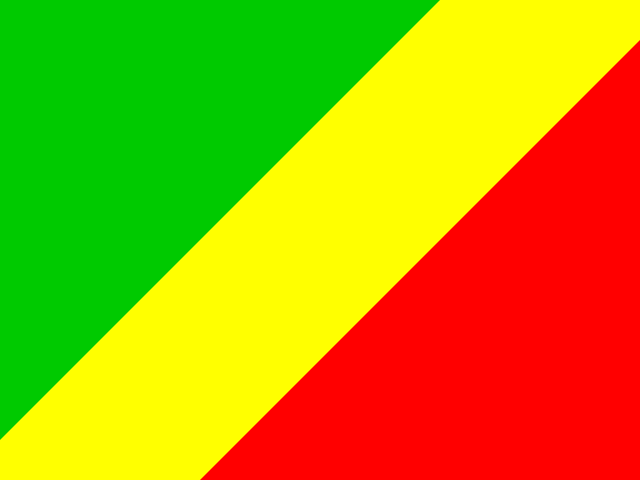
The Republic of the Congo carries a high flood risk and very high youth unemployment, alongside political stability that is decent by regional standards. Flooding at 7.6 out of 10 on INFORM is the principal natural hazard, while earthquakes, drought, cyclones and tsunami are practically absent; overall natural hazard is 3.3. On the World Bank scale, political stability is −0.26 — appreciably better than its neighbours — but control of corruption is −1.42, rule of law −1.18 and government effectiveness −1.11. Life expectancy is 66.0 years, health spending 75.55 dollars per person per year, water access reaches 73.49 percent of the population (the 2021 figure is flagged as stale), and PM2.5 stands at 36.54 micrograms per cubic metre. Road deaths run low at 8.4 per 100,000. Unemployment is 19.88 percent, and 40.5 among young people. A one-bedroom in Brazzaville rents for 219 euros with utilities at 56, and Pointe-Noire costs much the same. The immigration regime is set by Law No. 23-96 as amended by Law No. 29-2017, and it is the second that must be read: the amendment rewrote and renumbered all 48 articles at once. The structure is simple: visitors for up to three months (tourists, people on mission, businesspeople) and residents for longer than three. Residents come in two classes: ordinary, with a card for a year, and privileged, with a card for five. Settlement is granted on one condition — ten years of uninterrupted residence. The 2017 amendment, meanwhile, repealed a striking condition of the earlier version: before it, the privileged card was withheld from anyone aged 35 or over on entry, with allowances for children and for marriage to a Congolese. Marriage to a citizen gives the resident card AS OF RIGHT after two years, subject to three tested conditions: the union has not ceased, the spouse has retained their nationality, and a marriage celebrated other than by a Congolese registrar has been transcribed into the Congolese register. One feature to expect: the resident card must be applied for within fifteen days of entry, or the person is escorted to the border; anyone lodging a foreigner, even free of charge, must report it within twenty-four hours; and a change of residence is declared a day before and within two days after. What is not in this data: the Act sets no standard for the decision — all its deadlines are addressed to the foreigner or the host, and of the decision itself it says only that the applicant's resources are weighed. The procedure for bringing in cats and dogs is described neither by a national source nor by other countries' veterinary authorities: the British service holds certificates for Congo covering primates, pigs, meat and dairy products, but not pets. The conditions for citizenship lie in another instrument and were not read. City populations are not given: no official source separating the city from its department could be found.
Zambia in brief
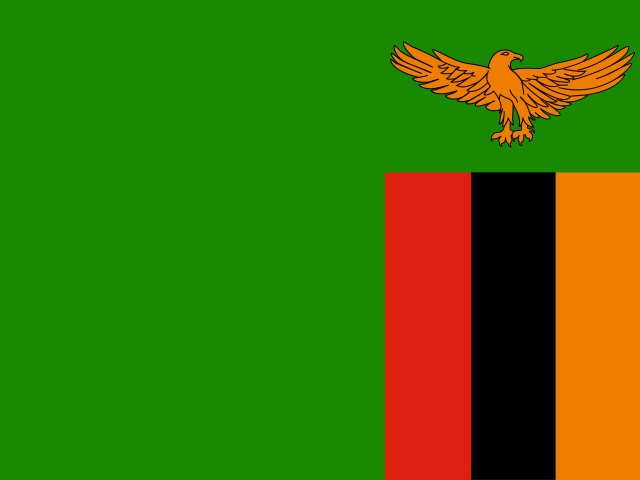
Zambia is a landlocked country in southern Africa whose economy relies on the mining and export of Copperbelt copper: according to the Zambia Statistics Agency, copper anode- and cathode-based goods are among the country's major export items. English is enshrined by Article 258(1) of the Constitution as the country's official language. Residence and work permits are issued by the Department of Immigration under the Immigration and Deportation Act No. 18 of 2010 in the form of twelve separate permit types - from the Employment Permit and Investor's Permit to the Spouse Permit, Study Permit and permanent residence (Residence Permit); the latter, under the general path, is granted after ten years of continuous work under an Employment Permit, with faster paths of three years under an Investor's Permit or five years under a Spouse Permit. Citizenship by registration (Article 37 of the 2016 Constitution and the Citizenship of Zambia Act, 2016) requires ten years of ordinarily resident residence under the general path, five years for those born in the country or descended from a citizen, and five years of marriage to a citizen; dual citizenship has been allowed under Article 39 of the Constitution since 5 January 2016. Importing dogs and cats requires an Import Permit from the Department of Veterinary Services and a veterinary certificate with a rabies vaccination; the law does not set a fixed mandatory quarantine period - the decision is made case by case. Malaria is endemic across most of the country. Electricity supply relies heavily on hydropower: according to a statement by the Minister of Energy to the National Assembly (5 July 2024), the El Niño-driven drought lowered water levels at the Kariba and Itezhi-Tezhi reservoirs so much that load-shedding began in March 2024, reaching up to 12 hours a day from May 2024. The five cities in the guide are Lusaka (capital and largest business centre), Kitwe and Ndola (the largest industrial centres of the Copperbelt), Livingstone (the city at Victoria Falls, the country's main tourist entry point) and Kabwe (the administrative centre of Central Province on the road between Lusaka and the Copperbelt).
Other comparisons
Republic of the Congo or… Nigeria · Rwanda · Tunisia · Algeria · Tanzania · Kenya · South Africa · Angola
Zambia or… Gabon · Madagascar · Sierra Leone · Uganda · Eswatini · Lesotho · Mozambique · Burundi
More on each: Republic of the Congo · Zambia. Build your own comparison — up to four countries
This material is for reference and is not legal, tax or immigration advice. Visa rules, tax thresholds and prices change. Before deciding anything, check the official sources and consult a licensed professional in the relevant country.