Togo or Tunisia
Two countries side by side across the same rows as the full comparison. A dash means the value is missing: fields are not filled with guesses. about the data
| Togo | Tunisia | |
|---|---|---|
| Salary in IT | — | — |
| Citizenship | — | — |
| Partner can work | yes | — |
| Parents | — | — |
| Pets | no trouble | no trouble |
| Pet limit | no limit | no limit |
| Quarantine | — | — |
| Residence permit fee | — | — |
| Rent, 2 bedrooms | $ 283 · estimate | $ 391 · estimate |
| Basket | $ 30,6 | $ 25,1 |
| Life expectancy | 62.94 | 76.71 |
| Homicides/100k | — | 4.69 |
| Natural hazards, 0–10 | 2.4 | 4.4 |
How the two sets of routes differ
Long-stay routes in this reference: Togo — 12, Tunisia — 33. Types present in both: work, study and family. Tunisia adds: investment, talent and retirement.
Fees, thresholds and deadlines
Togo: fees range from 5,000 to 800,000 XOF. Routes with a published decision deadline: 12; the shortest is 5 days. Tunisia: not a single route publishes its fee. Routes with a published decision deadline: 12; the shortest is 30 days.
Beyond the first permit
Permanent status: Tunisia after 5 years; the other country publishes no term.
Togo in brief
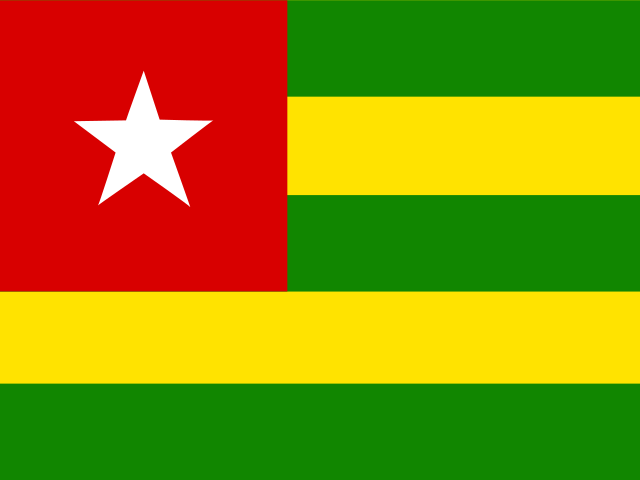
Togo is a country with weak institutions and moderate natural risks: political stability −0.81, government effectiveness −0.80, control of corruption −0.66 and rule of law −0.63 on the World Bank scale from −2.5 to +2.5. Life expectancy is 62.94 years, health spending 59.6 dollars per person a year, basic water access reaches 64.8 per cent of the population, and mean PM2.5 stands at 34.33 micrograms per cubic metre. Road deaths run at 22.7 per 100,000. Natural risk is 2.4 out of 10 on INFORM overall, with flooding at 3.0. The immigration framework, by contrast, is transparent and published in full by the authority itself: law No. 2022-005 and its implementing decree sit in the “Lois & Règlements” section of the Directorate General of National Documentation, and the law appears as an issue of the Official Gazette. The residence card becomes compulsory after six months and, by the law's own definition, itself confers the right to paid or unpaid employment: the country has no separate work permit as a document. The spouses and descendants of a card holder live on the same conditions as the holder. A visa decision comes within five days at most, a residence card in 30–45 days. What to watch for: penalties for missing deadlines are published and high by local standards — a million CFA francs for staying more than six months in a year without applying for a card, half a million for working without a card or an entry authorisation. Neither the law nor the decree names any condition for the five-year privileged card, so the period to permanent status is empty in the data.
Tunisia in brief
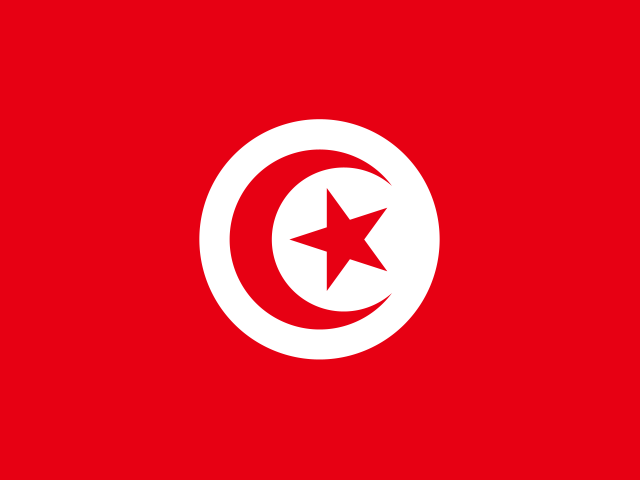
Tunisia is a North African republic on the Mediterranean coast with a relatively low cost of living and a small share of foreigners in its population: the 2024 census puts them at 0.55% (66,349 of 11,972,169 people, INS). The five cities described show different sides of the country: Tunis, the capital and business centre with a UNESCO-listed medina and the ruins of Carthage inside its metropolitan area; Sfax, the second-largest city and the industrial port of the south; Sousse, the resort centre of the Sahel whose medina and ribat were inscribed on the UNESCO World Heritage list in 1988; Hammamet, one of the country's oldest beach resorts on the Cap Bon peninsula; and Bizerte, a historic northern port beside the northernmost point of the African continent. Foreign workers face a branched system of work authorisations with several expressly described categories, including a simplified regime for companies covered by the 2016 investment law. Residence splits into temporary and ordinary: the temporary card is issued for no more than a year, while the ordinary one goes to a foreigner who has lived in the country for five uninterrupted years, to a foreign woman married to a Tunisian, to a foreigner with Tunisian children or one born in Tunisia, and it is valid for two years and renewable; Tunisian law knows no open-ended status. The right to ordinary residence is lost after an absence of more than six months without a return visa. The period to citizenship and the decision period for family applications remain unconfirmed: the nationality code could not be read in the primary source, and neither the law on the status of foreigners nor its implementing decree sets any decision periods. World Bank indices for political stability, control of corruption, rule of law and government effectiveness were all below zero in 2024 on the −2.5 to +2.5 scale, and youth unemployment exceeds 38%.
Other comparisons
Togo or… Nigeria · Rwanda · Algeria · Tanzania · Kenya · South Africa · Angola · Gabon
Tunisia or… Madagascar · Sierra Leone · Uganda · Zambia · Eswatini · Lesotho · Mozambique · Republic of the Congo
More on each: Togo · Tunisia. Build your own comparison — up to four countries
This material is for reference and is not legal, tax or immigration advice. Visa rules, tax thresholds and prices change. Before deciding anything, check the official sources and consult a licensed professional in the relevant country.