Mali or Namibia
Two countries side by side across the same rows as the full comparison. A dash means the value is missing: fields are not filled with guesses. about the data
| Mali | Namibia | |
|---|---|---|
| Salary in IT | — | — |
| Citizenship | — | 5 years |
| Partner can work | — | no |
| Parents | — | — |
| Pets | no trouble | difficult |
| Pet limit | no limit | no limit |
| Quarantine | no | — |
| Residence permit fee | — | — |
| Rent, 2 bedrooms | $ 352 · estimate | $ 662 · estimate |
| Basket | $ 19,9 | $ 29,2 |
| Life expectancy | 60.67 | 67.52 |
| Homicides/100k | — | 11.21 |
| Natural hazards, 0–10 | 4.2 | 4.1 |
How the two sets of routes differ
Long-stay routes in this reference: Mali — 10, Namibia — 8. Types present in both: work, study and family. Mali adds: investment and retirement. Namibia adds: remote work.
Fees, thresholds and deadlines
Mali: not a single route publishes its fee. Namibia: fees range from 600 to 20,000 NAD. Routes stating an income threshold: 1; the lowest is 2,000 USD a month. Routes with a published decision deadline: 7; the shortest is 7 days.
Beyond the first permit
Citizenship: Namibia after 5 years; the other country publishes no term.
Mali in brief
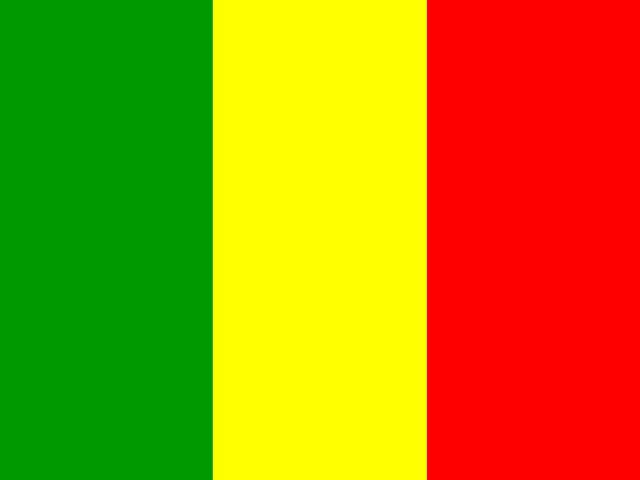
Mali has the second-lowest political stability figure in this guide: −2.49 on the World Bank scale among the 173 countries with data. Government effectiveness is −1.29 (fifteenth from the bottom out of 172), rule of law −1.09 and control of corruption −0.98. Life expectancy is 60.67 years — seventh from the bottom out of 174. Health spending is 33.98 dollars per person per year, twelfth from the bottom out of 167. Basic water access reaches 86.36 percent of the population, with a mean PM2.5 concentration of 35.52 micrograms per cubic metre. Road deaths run at 20.2 per 100,000. Overall natural hazard is 4.2 out of 10 on INFORM, and unusually double-edged: flooding at 7.9 and drought at 7.4 together, while earthquakes are almost absent (0.1) and there is no sea at all — coastal, cyclone and tsunami exposure are all zero. Unemployment is 2.83 percent and 3.88 among young people: as with its regional neighbours, that describes an almost wholly informal labour market rather than ease of finding work. Prices are low: a one-bedroom in Bamako rents for 228 euros a month, with utilities at 54 and a monthly transit pass at 12.21 dollars. The immigration regime is published as a pair — Law No. 04-058 of 2004 and Decree No. 05-322 of 2005 — and together they set out the whole procedure. What defines it is a fork at the entrance: the Act divides foreigners into non-immigrants and immigrants by INTENTION rather than by occupation, and which one you claim determines your document. A non-immigrant gets a residence visa of no more than a year, renewable. An immigrant gets a resident card for five years — but the application for it is lodged within 15 DAYS of entry, so the choice must be made at once. There is no permanent status in the country: the Act's establishment section runs to three articles, and its maximum is that same five-year renewable card. It also lapses of its own accord if the holder has been away for more than six consecutive months. Marriage to a citizen gives a residence authorisation AS OF RIGHT rather than at the authority's discretion — provided the marriage is at least three months old. The same provision grants it as of right to citizens' children, to the dependent ascendants of a citizen's spouse, to the parent of a Malian child, and to the family of a resident-card holder. One feature is rare even for the region: residence is conditioned on a REPATRIATION GUARANTEE, and it applies even to nationals of countries with which Mali has freedom-of-movement agreements. The deposit equals the price of a ticket in the most economical class and is paid into the Treasury within 15 days of arrival; exempt are diplomats, officials and military personnel on mission, nationals of bordering countries travelling by land, tourists in their own vehicles, and students at Malian institutions. What is not in this data: neither instrument sets a processing standard — the Act's 27 articles and the decree's 74 were read in full, and while deadlines abound in them, every one is addressed to the foreigner or the carrier, none to the authority. The conditions for citizenship lie in the Nationality Code of 1995, which was not read on this pass. The city's population is not given: no official source separating Bamako from the district could be found.
Namibia in brief
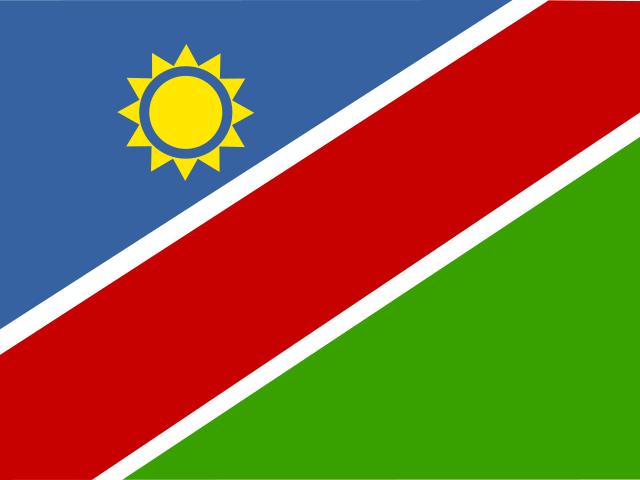
Namibia regulates labour migration under the Immigration Control Act 7 of 1993: a short-term work visa runs from 1 day to 6 months with no right of renewal beyond that period within a calendar year, an Employment Permit runs from 6 months to 2 years and is tied to a specific employer and position, and the Permanent Residence Permit is issued by the Immigration Selection Board at its discretion, with no statutory minimum period of residence. A digital nomad visa has been in place since 2022, with an income threshold of $2,000 a month and up and a stay of up to 6 months with no renewal. Naturalisation is possible after 5 years of continuous residence, but years spent on fixed-term permits, including a work visa, do not count towards this period (art. 5(3)(b), Namibian Citizenship Act 14 of 1990), and the applicant must renounce their foreign citizenship (art. 5(1)(g)); citizens by birth and by descent are not subject to such renunciation or deprivation (art. 4(8), Namibian Constitution). Between Namibia and South Africa, a simplified pet movement regime operates within the Southern African Customs Union; for other countries, the general procedure applies with an import veterinary permit. The country faces a structural water shortage: the INFORM drought risk indicator is 9.4 out of 10 (2026), and access to basic water supply covers 86.5% of the population (World Bank, 2024). Income inequality is among the highest in the world, with a Gini index of 59.1 (World Bank, 2015 data).
Other comparisons
Mali or… Nigeria · Rwanda · Tunisia · Algeria · Tanzania · Kenya · South Africa · Angola
Namibia or… Gabon · Madagascar · Sierra Leone · Uganda · Zambia · Eswatini · Lesotho · Mozambique
More on each: Mali · Namibia. Build your own comparison — up to four countries
This material is for reference and is not legal, tax or immigration advice. Visa rules, tax thresholds and prices change. Before deciding anything, check the official sources and consult a licensed professional in the relevant country.