India or Nepal
Two countries side by side across the same rows as the full comparison. A dash means the value is missing: fields are not filled with guesses. about the data
| India | Nepal | |
|---|---|---|
| Salary in IT | — | — |
| Citizenship | 12 years | 15 years |
| Partner can work | — | — |
| Parents | — | — |
| Pets | no trouble | difficult |
| Pet limit | 2 | no limit |
| Quarantine | no | — |
| Residence permit fee | — | — |
| Rent, 2 bedrooms | $ 782 · estimate | $ 254 · estimate |
| Basket | $ 14,2 | $ 15,8 |
| Life expectancy | 72.23 | 70.64 |
| Homicides/100k | 2.72 | 2.13 |
| Natural hazards, 0–10 | 7.8 | 5.1 |
How the two sets of routes differ
Long-stay routes in this reference: India — 17, Nepal — 22. Types present in both: work, study, family, investment and repatriation. Nepal adds: talent and retirement.
Fees, thresholds and deadlines
India: the fee is 100 INR wherever it is published. Routes with a published decision deadline: 1; the shortest is 30 days. Nepal: fees range from 10 to 700 USD. Routes with no fee: 1. Routes stating an income threshold: 5; the lowest is 3,000 USD a year. Routes with a published decision deadline: 22; the shortest is 1 days.
Beyond the first permit
Permanent status: India with no residence period; the other country publishes no term. Citizenship: India after 12 years, Nepal after 15 years. Neither recognises a second citizenship.
India in brief
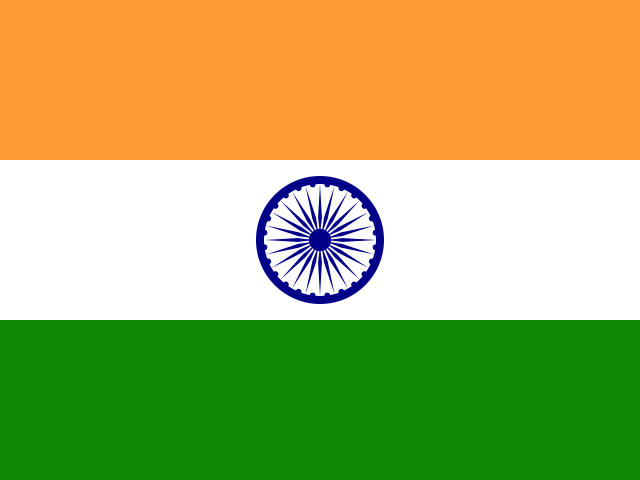
India is the world's second-most-populous labour market, with high demand for skilled IT and engineering professionals and a globally low cost of living: rent and utility payments are several times lower than in Europe, even in the largest cities. The work visa is rigidly tied to the employer — it cannot be changed without leaving the country — and is issued only for an annual salary above 1,625,000 rupees, except for a few exempt categories. There is no general mechanism for permanent residence by length of stay: status is renewed through annual work visas via the FRRO, and Permanent Residency Status (PRS) is granted only to foreign investors who invest at least 10 crore rupees. Naturalisation requires about 12 years of residence in the country, and dual citizenship is not allowed. The northern plain suffers from smog in winter, while the coastal and mountain regions suffer from monsoon flooding and earthquakes. The country's five largest cities differ sharply in character: from the financial capital Mumbai and the technology cluster Bangalore to the UNESCO World Heritage sites in Jaipur and Agra.
Nepal in brief
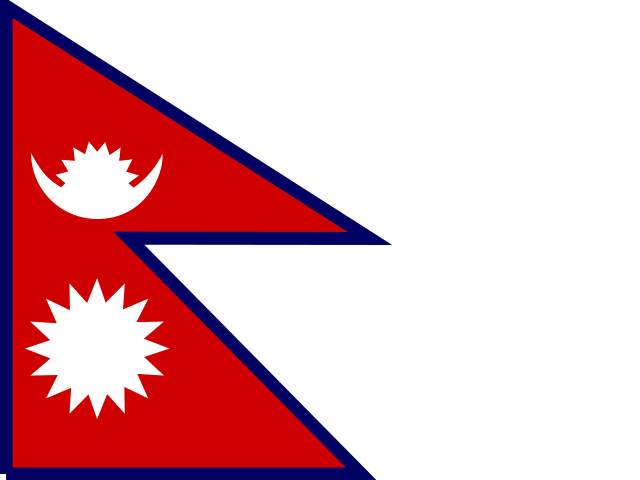
Nepal is a South Asian country outside the EU and outside the Gulf, with a narrow system of long-stay visas: the work visa is issued under the general “non-tourist visa” category and requires a separate permit from the Government of Nepal for paid employment (via the Department of Labour), issued for no more than 1 year at a time; the business visa for investors — up to 5 years; the Non-Resident Nepali (NRN) visa — up to 10 years, but available only to people of Nepali origin or citizens of Nepal who have long lived abroad; the residential visa for investors of USD 100,000 or more, or for persons of international standing, is issued by the Department of Immigration for the first year and then renewed annually, without automatically becoming a permanent status — Nepali law has no permanent residence permit in the European sense. Naturalisation to Nepali citizenship is available in practice almost exclusively to persons with a special contribution to the country's development, requires 15 years of residence, knowledge of Nepali or another language used in Nepal, and renunciation of prior citizenship; dual citizenship is not permitted in any form. An expedited route to citizenship through marriage exists only for foreign wives of Nepali citizens, not for foreign husbands of Nepali female citizens. Seismic hazard here is not a technical detail but a systemic fact: the country lies in the collision zone of the Indian and Eurasian plates, INFORM rates the earthquake component at 9.8 out of 10, and the 25 April 2015 Gorkha earthquake (M7.8) claimed almost 9,000 lives and damaged a significant part of the historic building stock of the Kathmandu Valley. At the same time, the country holds several UNESCO World Heritage sites (the Kathmandu Valley, Lumbini — the birthplace of Buddha, Chitwan National Park), and the cost of rent and living is lower than the regional average.
Other comparisons
India or… Taiwan · South Korea · Japan · Thailand · Kazakhstan · Lebanon · Uzbekistan · Malaysia
Nepal or… Azerbaijan · Philippines · Bangladesh · Kuwait · Iraq · Mongolia · Oman · People's Republic of China
More on each: India · Nepal. Build your own comparison — up to four countries
This material is for reference and is not legal, tax or immigration advice. Visa rules, tax thresholds and prices change. Before deciding anything, check the official sources and consult a licensed professional in the relevant country.