Egypt or The Gambia
Two countries side by side across the same rows as the full comparison. A dash means the value is missing: fields are not filled with guesses. about the data
| Egypt | The Gambia | |
|---|---|---|
| Salary in IT | — | — |
| Citizenship | 10 years | — |
| Partner can work | — | — |
| Parents | — | — |
| Pets | difficult | difficult |
| Pet limit | no limit | no limit |
| Quarantine | — | — |
| Residence permit fee | — | — |
| Rent, 2 bedrooms | $ 291 · estimate | $ 122 · estimate |
| Basket | $ 13,6 | $ 19,2 |
| Life expectancy | 71.81 | 66.06 |
| Homicides/100k | 1.31 | — |
| Natural hazards, 0–10 | 6.2 | 2.9 |
How the two sets of routes differ
Long-stay routes in this reference: Egypt — 3, The Gambia — 6. Types present in both: work. The set of types is identical — the difference is in how many routes there are and on what terms, not in the types themselves.
Fees, thresholds and deadlines
Egypt: fees range from 30 to 65 USD. The Gambia: fees range from 100 to 7,700 GMD.
Beyond the first permit
Permanent status: Egypt with no residence period; the other country publishes no term. Citizenship: Egypt after 10 years; the other country publishes no term.
Egypt in brief
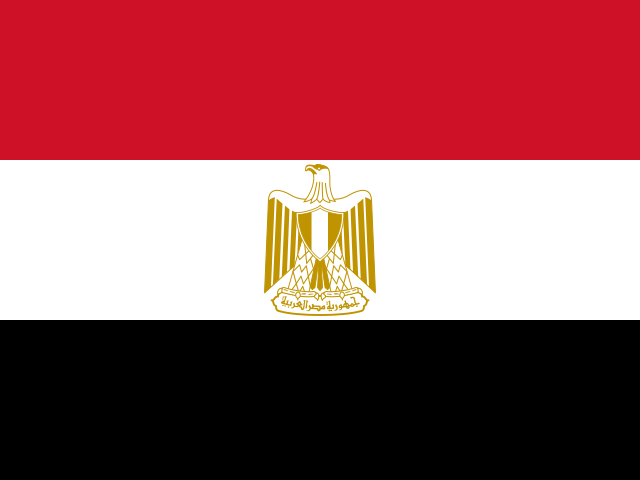
Egypt is the most populous Arab country (around 107 million people in 2024 according to CAPMAS), with several parallel formal residence statuses for foreigners: employment residence through a Ministry of Manpower permit, student residence, citizenship in exchange for investment, and a residence permit for property ownership (a programme in place since the early 2020s). Naturalisation by investment requires no minimum period of prior residence: the decision is made by the prime minister on the recommendation of the specialised unit at the General Authority for Investment and Free Zones (GAFI), in exchange for an investment project, a property purchase or a foreign-currency deposit. Standard naturalisation on general grounds takes 10 years of residence and requires command of Arabic; dual citizenship is generally allowed with the authorities' permission. The cost of living is markedly lower than in Europe. Rule-of-law and control-of-corruption scores under the World Bank's methodology (WGI) are negative. Of the country's five largest and most tourism-significant cities, two — Hurghada and Sharm El Sheikh — are entirely oriented toward Red Sea tourism and have historically been sensitive to fluctuations in international air links.
The Gambia in brief
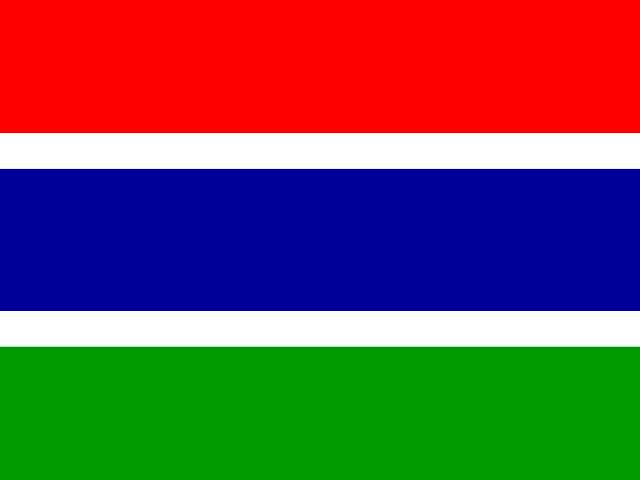
The Gambia is very cheap and very poor at the same time. **A monthly transit pass at 6.55 dollars is the cheapest in this guide**, and a one-bedroom in Banjul rents for 80 euros with utilities at 26. And alongside that: health spending of 25.74 dollars per person per year — fifth from the bottom among 167 countries. Life expectancy is 66.06 years, basic water access reaches 87.1 percent of the population, PM2.5 stands at 38.27 micrograms per cubic metre (the twenty-fourth highest of 170), and road deaths run at 22.0 per 100,000. Unemployment is 6.52 percent, and 10.86 among young people. Overall natural hazard is 2.9 out of 10 on INFORM and almost entirely water-borne: flooding 4.6, drought 3.0, coastal hazards 2.5, tsunami 1.1, with earthquakes and cyclones practically absent. On the World Bank scale the governance figures are appreciably better than the regional norm: political stability −0.02, control of corruption −0.33, rule of law −0.39 and government effectiveness −0.54. The Immigration Department sets out the procedure in detail. A visa may be single journey, multiple journey (valid no longer than 12 months), transit, diplomatic (heads of missions only, and free) or short visit for 90 days; ECOWAS citizens need no visa. The service states twice that issuing a visa does not guarantee entry: the final decision rests with the officer at the port of arrival. There are two classes of residence permit: A — to live without gainful employment (students, retirees, short business visits) — and B, to live and work. The distinction by nationality runs through everything: an ECOWAS citizen obtains a permit after up to 90 days in the country, while a non-ECOWAS citizen must reside for up to 56 days after admission before a permit can be issued at all, and additionally receives an Alien Card. Fees run from 3,100 to 7,700 dalasi. Hiring is bounded by a QUOTA rather than a procedure: 80 percent of a workforce must be Gambians and 20 percent foreigners with skills unavailable in the country, and the Ministry of Trade administers it. Working without a residence and work permit is an offence. Family is arranged without a document of its own: the children and direct dependants of a permit holder are covered by that same permit, but on reaching adulthood must obtain one of their own. What is not in this data: there is no permanent residence in the department's catalogue, but a catalogue is not a law, and the Immigration Act itself is not published, so the number of years to permanent residence is left empty. The department publishes no processing standard for any of the seven steps of its own "processing cycle". The road to citizenship, by contrast, is published and long: seven years of residence from the date of marriage, or fifteen years by naturalisation. For cats there is no data at all — the British veterinary certificate for The Gambia covers only dogs. The city's population is not given: no official source separating Banjul from its area could be found.
Other comparisons
Egypt or… Nigeria · Rwanda · Tunisia · Algeria · Tanzania · Kenya · South Africa · Angola
The Gambia or… Gabon · Madagascar · Sierra Leone · Uganda · Zambia · Eswatini · Lesotho · Mozambique
More on each: Egypt · The Gambia. Build your own comparison — up to four countries
This material is for reference and is not legal, tax or immigration advice. Visa rules, tax thresholds and prices change. Before deciding anything, check the official sources and consult a licensed professional in the relevant country.