Cameroon or Namibia
Two countries side by side across the same rows as the full comparison. A dash means the value is missing: fields are not filled with guesses. about the data
| Cameroon | Namibia | |
|---|---|---|
| Salary in IT | — | — |
| Citizenship | — | 5 years |
| Partner can work | — | no |
| Parents | — | — |
| Pets | no trouble | difficult |
| Pet limit | no limit | no limit |
| Quarantine | no | — |
| Residence permit fee | — | — |
| Rent, 2 bedrooms | $ 807 · estimate | $ 662 · estimate |
| Basket | $ 34,0 | $ 29,2 |
| Life expectancy | 63.97 | 67.52 |
| Homicides/100k | 6.76 | 11.21 |
| Natural hazards, 0–10 | 3.5 | 4.1 |
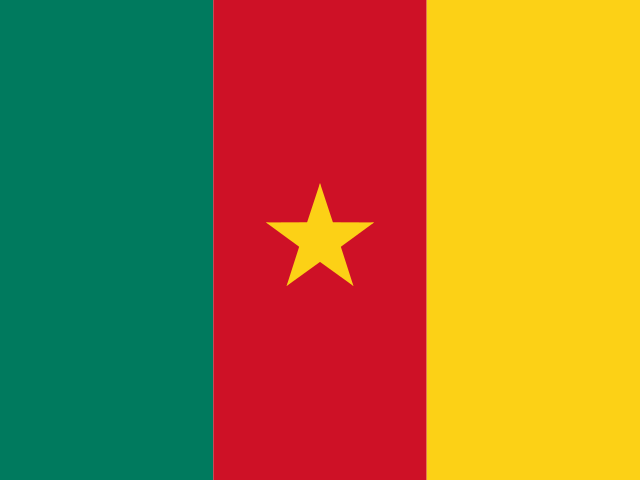
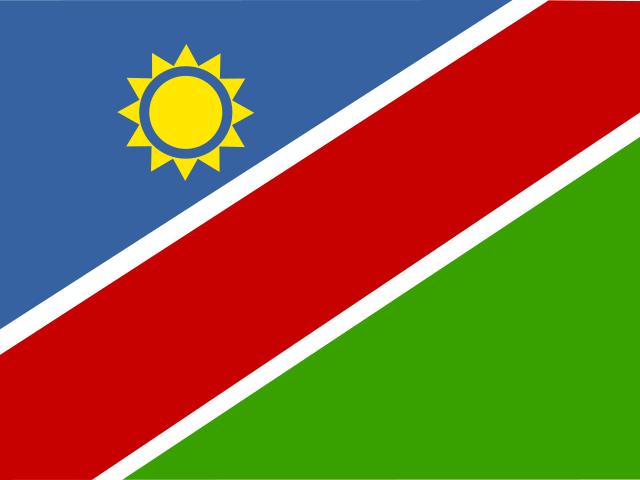
How the two sets of routes differ
Long-stay routes in this reference: Cameroon — 10, Namibia — 8. Types present in both: work, study and family. Namibia adds: remote work.
Fees, thresholds and deadlines
Cameroon: fees range from 75,000 to 750,000 XAF. Routes with no fee: 1. Routes with a published decision deadline: 5; the shortest is 3 days. Namibia: fees range from 600 to 20,000 NAD. Routes stating an income threshold: 1; the lowest is 2,000 USD a month. Routes with a published decision deadline: 7; the shortest is 7 days.
Beyond the first permit
Permanent status: Cameroon after 4 years; the other country publishes no term. Citizenship: Namibia after 5 years; the other country publishes no term.
Cameroon in brief
Cameroon is a country with very dirty air and a marked price gap between its two main cities. On the World Bank scale from −2.5 to +2.5, political stability stands at −1.56, rule of law at −1.25, control of corruption at −1.22 and government effectiveness at −0.80. Life expectancy is 63.97 years, health spending 79.10 dollars per person a year, and basic water access reaches 71.41 per cent of the population. Mean PM2.5 concentration is 55.6 micrograms per cubic metre, one of the worst figures in the sample. Homicides run at 6.76 per 100,000, road deaths at 10.6 per 100,000, and the Gini index is 42.2. Natural risk overall is 3.5 out of 10 on INFORM and almost entirely water-related: floods 6.7, droughts 3.4, coastal hazards 2.6, whereas earthquakes are at 0.1 and there are no cyclones or tsunamis at all. The immigration framework has been published by the agency in full and rests on a single rule worth grasping in advance: the right to work is conferred not by the residence card but by the visa. Only the long-stay visa opens the right to paid activity and to study, and it is also a mandatory condition for the residence card. The employment contract, moreover, is endorsed by the labour minister before entry. The agencies state the visa issuing standard differently: the foreign ministry says 72 hours after pre-registration and 24 hours under the expedited procedure, DGSN says no more than 48 hours. The residence card is valid for two years and is renewed twice, the resident card for ten years; under decree No. 2025/059 of 28 February 2025 it is obtained after the SECOND renewal of the residence card, whereas the former section of the DGSN site spoke of the third. There is also a direct route through marriage, but here too the agency's texts diverge: the new section writes “the spouse of a person of foreign nationality”, the former one “the spouse of a Cameroonian citizen”. In both documents the fee depends on the applicant's nationality rather than on the type of document, and a separate rate is set aside for the French. What is not in this data: the agency publishes a processing standard only for the visa, but not for the residence card or the resident card; city populations are not given, because no official source separating the city from the region was found. The rent gap between Douala and Yaoundé is taken from the source as it stands — it is reproduced across all the lines, not just one, and the source offers no explanation for it.
Namibia in brief
Namibia regulates labour migration under the Immigration Control Act 7 of 1993: a short-term work visa runs from 1 day to 6 months with no right of renewal beyond that period within a calendar year, an Employment Permit runs from 6 months to 2 years and is tied to a specific employer and position, and the Permanent Residence Permit is issued by the Immigration Selection Board at its discretion, with no statutory minimum period of residence. A digital nomad visa has been in place since 2022, with an income threshold of $2,000 a month and up and a stay of up to 6 months with no renewal. Naturalisation is possible after 5 years of continuous residence, but years spent on fixed-term permits, including a work visa, do not count towards this period (art. 5(3)(b), Namibian Citizenship Act 14 of 1990), and the applicant must renounce their foreign citizenship (art. 5(1)(g)); citizens by birth and by descent are not subject to such renunciation or deprivation (art. 4(8), Namibian Constitution). Between Namibia and South Africa, a simplified pet movement regime operates within the Southern African Customs Union; for other countries, the general procedure applies with an import veterinary permit. The country faces a structural water shortage: the INFORM drought risk indicator is 9.4 out of 10 (2026), and access to basic water supply covers 86.5% of the population (World Bank, 2024). Income inequality is among the highest in the world, with a Gini index of 59.1 (World Bank, 2015 data).
Other comparisons
Cameroon or… Nigeria · Rwanda · Tunisia · Algeria · Tanzania · Kenya · South Africa · Angola
Namibia or… Gabon · Madagascar · Sierra Leone · Uganda · Zambia · Eswatini · Lesotho · Mozambique
More on each: Cameroon · Namibia. Build your own comparison — up to four countries
This material is for reference and is not legal, tax or immigration advice. Visa rules, tax thresholds and prices change. Before deciding anything, check the official sources and consult a licensed professional in the relevant country.