Botswana or Ethiopia
Two countries side by side across the same rows as the full comparison. A dash means the value is missing: fields are not filled with guesses. about the data
| Botswana | Ethiopia | |
|---|---|---|
| Salary in IT | — | — |
| Citizenship | 10 years | 4 years |
| Partner can work | no | — |
| Parents | — | — |
| Pets | no trouble | difficult |
| Pet limit | no limit | no limit |
| Quarantine | no | — |
| Residence permit fee | — | — |
| Rent, 2 bedrooms | $ 360 · estimate | $ 848 · estimate |
| Basket | $ 21,0 | $ 29,6 |
| Life expectancy | 69.29 | 67.6 |
| Homicides/100k | 12.98 | 8.51 |
| Natural hazards, 0–10 | 2.2 | 3.7 |

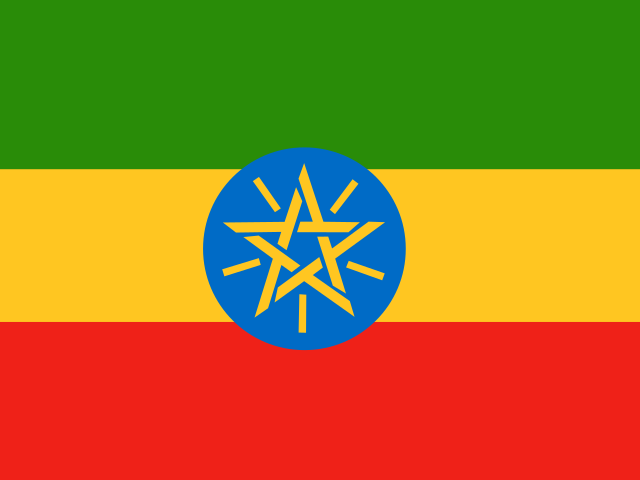
How the two sets of routes differ
Long-stay routes in this reference: Botswana — 14, Ethiopia — 17. Types present in both: work, study and investment. Botswana adds: family.
Fees, thresholds and deadlines
Botswana: fees range from 1,500 to 3,000 BWP. Routes with a published decision deadline: 13; the shortest is 7 days. Ethiopia: fees range from 32 to 1,002 USD. Routes with a published decision deadline: 10; the shortest is 3 days.
Beyond the first permit
Permanent status: Botswana after 5 years; the other country publishes no term. Citizenship: Botswana after 10 years, Ethiopia after 4 years. Neither recognises a second citizenship.
Botswana in brief
Botswana regulates labour and permanent migration through the Department of Immigration and Citizenship (Ministry of Labour and Home Affairs): the official categories are the Work Permit (14 working days to process), the Residence Permit (30 working days), the Exemption Certificate, which exempts certain categories of foreigners from the Work Permit requirement (7 working days), and the Permanent Residence Permit, which requires a minimum of 5 years of continuous lawful residence — except for the investor category, to which this threshold does not apply; the official page gives the processing time both as "56 working days" and as "about six months". Ordinary naturalisation requires at least 10 years of residence in total and the last 12 months continuously before applying, and concludes with a mandatory renunciation of foreign citizenship; for spouses of Botswana citizens the threshold is reduced to 5 years of residence within the marriage. Dual citizenship is preserved without restriction only for those who acquired it by birth or by descent; those who acquire Botswana citizenship by registration, naturalisation or marriage must renounce their foreign citizenship, while citizens by birth/descent who simultaneously hold foreign citizenship must choose a single citizenship by age 21 or automatically lose Botswana citizenship. The import of dogs and cats is handled by the Department of Veterinary Services as an import permit: a valid rabies vaccination certificate and an inspection of the animal before the permit is issued are required — quarantine and rabies antibody titration are not among the listed requirements, and the permit is issued within 1 working day. The country's economy has historically relied on diamond mining and exports: in May 2026 diamonds accounted for 59.0% of all merchandise exports (Statistics Botswana). Access to basic water supply covers 91.77% of the population (World Bank, 2024), and the INFORM drought risk indicator is 5.4 out of 10 (2026). HIV prevalence among adults aged 15–49 is 15.7% (WHO, Global Health Observatory, 2024) — one of the highest rates in the world and a significant factor when planning health insurance and access to treatment.
Ethiopia in brief
Immigration Proclamation No. 354/2002 defines nine visa types — including business, immigrant, student, tourist and transit — issued by the Authority for Security, Immigration and Refugee Affairs; some are available through the evisa.gov.et e-portal. No separately named "investor visa" was found in law: the Ethiopian Investment Commission directs investors to the general business visa, valid from 30 days to 12 months. The law introduces the status of a temporary or permanent residence permit, but the conditions for moving between them and the number of years of waiting are not defined in the text of the law itself — they are assigned to separate Regulations, unavailable in open sources this session. Naturalisation on the general ground requires domicile and at least 4 years' residence in the country, knowledge of one of the nations' and nationalities' languages, a lawful source of income, no criminal record, and renouncing prior nationality (Ethiopian Nationality Proclamation No. 378/2003); for spouses of Ethiopian citizens the period is reduced to 2 years from the marriage with at least 1 year of residence. Dual nationality is not permitted by law: voluntary acquisition of a foreign nationality is deemed a voluntary renunciation of Ethiopian nationality. For persons of Ethiopian origin in that situation, a separate status is provided — the Yellow Card (Proclamation No. 270/2002), granting a broad range of rights and privileges without nationality itself; a decision on the application is made within 30 days, and the card is valid for 5 years. The Constitution establishes land as the state and common property of the country's nations, nationalities and peoples: it may not be sold or otherwise alienated by anyone, including citizens, and private investors receive only a right of use on lease terms. Importing pets requires a permit from the relevant agency under the general agricultural regulation (Animal Health and Welfare Proclamation No. 1376/2025) — an import permit, an international veterinary certificate, and entry through a designated crossing point — but the specific quarantine period and antibody-titre requirement for dogs and cats are not defined in the open text of the law. The country has been landlocked since 1993 and lives by its own calendar, running 7–8 years behind the Gregorian one. The five cities in this reference guide are Addis Ababa (the capital, at an elevation of about 2,355 m), Dire Dawa (the second-largest city and a railway hub), Mekelle (administrative centre of the Tigray region), and Lalibela and Gondar — two stops on the historic tourist route with UNESCO World Heritage sites.
Other comparisons
Botswana or… Nigeria · Rwanda · Tunisia · Algeria · Tanzania · Kenya · South Africa · Angola
Ethiopia or… Gabon · Madagascar · Sierra Leone · Uganda · Zambia · Eswatini · Lesotho · Mozambique
More on each: Botswana · Ethiopia. Build your own comparison — up to four countries
This material is for reference and is not legal, tax or immigration advice. Visa rules, tax thresholds and prices change. Before deciding anything, check the official sources and consult a licensed professional in the relevant country.