Bolivia or Ecuador
Two countries side by side across the same rows as the full comparison. A dash means the value is missing: fields are not filled with guesses. about the data
| Bolivia | Ecuador | |
|---|---|---|
| Salary in IT | — | — |
| Citizenship | 3 years | 3 years |
| Partner can work | yes | yes |
| Parents | straightforward | — |
| Pets | no trouble | no trouble |
| Pet limit | no limit | no limit |
| Quarantine | no | no |
| Residence permit fee | — | — |
| Rent, 2 bedrooms | $ 461 · estimate | $ 637 · estimate |
| Basket | $ 20,8 | $ 23,4 |
| Life expectancy | 68.74 | 77.58 |
| Homicides/100k | 3.65 | 38.94 |
| Natural hazards, 0–10 | 4.7 | 6.5 |
How the two sets of routes differ
Long-stay routes in this reference: Bolivia — 23, Ecuador — 32. Types present in both: work, study, family and investment. Ecuador adds: remote work, talent, retirement and working holiday.
Fees, thresholds and deadlines
Bolivia: every route that publishes a fee charges nothing. Ecuador: fees range from 30 to 270 USD. Routes with no fee: 5. Routes stating an income threshold: 2; the lowest is 724 USD a month. Routes with a published decision deadline: 31; the shortest is 60 days.
Beyond the first permit
Permanent status: Bolivia after 3 years, Ecuador after 2 years. Citizenship: both after 3 years. Both allow a second citizenship.
Bolivia in brief
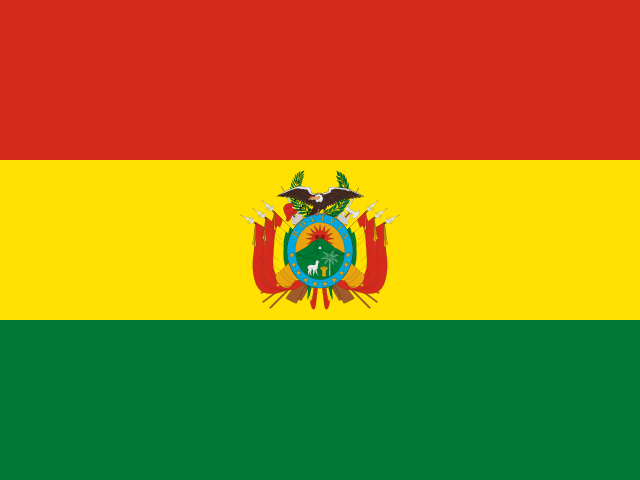
Bolivia stands out for its timelines: open-ended status is available after 3 years of residence, citizenship also after 3 years, dual citizenship is allowed, and the law sets no language requirement. The constraint is procedural: entry must be on a purpose-specific visa for 30 days and status is then arranged inside the country, and the law sets no calendar processing deadlines for family-based applications.
Ecuador in brief
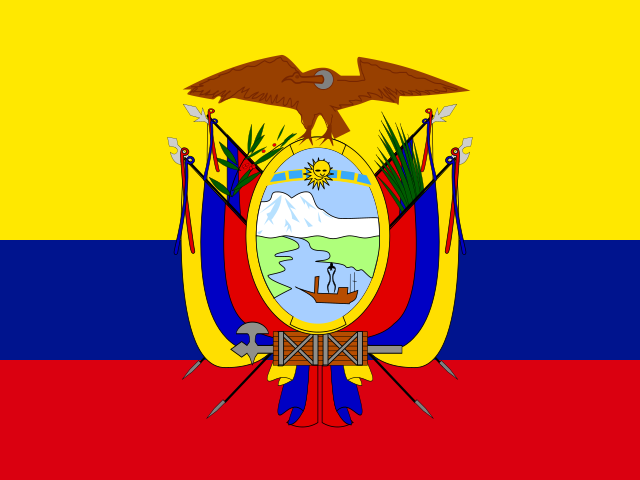
Ecuador has been dollarised since 2000: its official currency is the US dollar rather than a national currency, which removes currency risk for those whose income or savings are in dollars, but deprives the country itself of independent monetary policy. The temporary residence system is governed by the 2023 Ley Orgánica de Movilidad Humana: the rentista, pensionista/jubilado, inversionista and professional categories are defined not by a fixed dollar amount but by a threshold in SBU — the minimum wage, which is revised annually; since 2022–2023 a separate visa for remote employees of foreign companies has been added among them. Permanent residence is available after just 21 months of continuous residence on a temporary visa, and citizenship after a further 3 years of lawful residence as a permanent resident, and the Constitution explicitly permits not renouncing one's original citizenship. A separate part of the country's territory is the Galápagos archipelago: it is governed under a special law, LOREG, through its own body (Consejo de Gobierno de Régimen Especial de Galápagos), and moving there to settle permanently is not among the rights even of a permanent resident of mainland Ecuador — a separate migration qualification is required. Governance indicators (rule of law, control of corruption) and the homicide rate are, according to official statistics, among the weakest and highest in South America respectively.
Other comparisons
Bolivia or… Panama · Costa Rica · Peru · Trinidad and Tobago · El Salvador · Cuba · Guyana · Honduras
Ecuador or… Nicaragua · Belize · Colombia · Greenland · Jamaica · Bahamas · Guatemala · Dominican Republic
More on each: Bolivia · Ecuador. Build your own comparison — up to four countries
This material is for reference and is not legal, tax or immigration advice. Visa rules, tax thresholds and prices change. Before deciding anything, check the official sources and consult a licensed professional in the relevant country.