Brunei or South Korea
Two countries side by side across the same rows as the full comparison. A dash means the value is missing: fields are not filled with guesses. about the data
| Brunei | South Korea | |
|---|---|---|
| Salary in IT | — | $ 61 452 |
| Citizenship | 20 years | 5 years |
| Partner can work | no | no |
| Parents | — | difficult |
| Pets | no trouble | difficult |
| Pet limit | no limit | 5 |
| Quarantine | no | 10 days |
| Residence permit fee | — | — |
| Rent, 2 bedrooms | $ 946 · estimate | $ 999 · estimate |
| Basket | $ 31,6 | $ 40,9 |
| Life expectancy | 75.5 | 83.63 |
| Homicides/100k | 0.49 | 0.49 |
| Natural hazards, 0–10 | 2.8 | 6 |
How the two sets of routes differ
Long-stay routes in this reference: Brunei — 19, South Korea — 91. Types present in both: work, family, investment, talent and repatriation. South Korea adds: study, startup, job seeking and working holiday.
Fees, thresholds and deadlines
Brunei: the fee is 50 BND wherever it is published. South Korea: fees range from 60 to 90 USD. Routes stating an income threshold: 1; the lowest is 1,500,000,000 KRW a month.
Beyond the first permit
Permanent status: South Korea after 5 years; the other country publishes no term. Citizenship: Brunei after 20 years, South Korea after 5 years. Neither recognises a second citizenship.
Brunei in brief
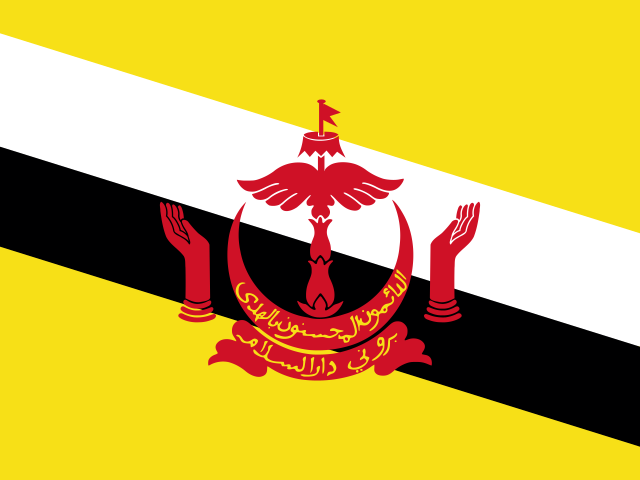
Brunei is an oil-and-gas monarchy on the island of Borneo with one of the most closed long-term entry regimes in the world. The grounds for working residence are the Employment Pass, rigidly tied to a specific employer and requiring the employer to hold a Foreign Workers Licence from the Department of Labour, the Professional Visit Pass for select categories of experts, the Dependant's Pass for family members, and the Student's Pass. For none of these categories does the immigration service's official website publish processing times. There is no separate permanent residence status with a published number of years: the closest analogue, the Entry Permit, is granted at the discretion of the Controller of Immigration without an objective criterion. Naturalisation is governed by the Brunei Nationality Act (Cap. 15): 20 years of residence in the country out of the preceding 25 years, an oral exam in Malay before the Language Board, and a decision made entirely at the Sultan's discretion; time spent in the country on temporary passes (including work passes) does not count toward this period unless the Sultan directs otherwise. Dual citizenship is not permitted. There is no personal income tax — the Income Tax Act taxes only the income of legal entities. The country's economy rests on the extraction and export of oil and natural gas. Since 2014 the Syariah Penal Code Order, 2013 has been phased in and is in force; under the code's direct provision (s. 3(1)) it applies to both Muslims and non-Muslims unless expressly stated otherwise, and it includes hudud and qisas categories of offences. The sale of alcohol is banned throughout the country (Excise Order, 2006, s. 73).
South Korea in brief
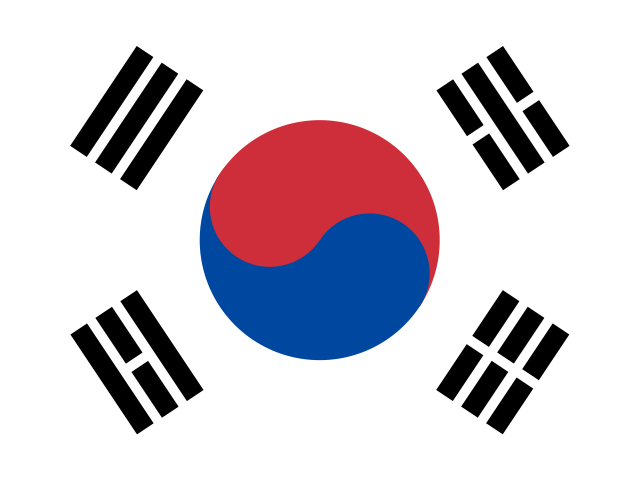
South Korea combines a developed technology economy and low violent crime with a formal points system for long-term residence (E-7 → F-2-7 → F-5) and substantial restrictions on dual citizenship and on a spouse working. Parents, your own or a partner's, can only get the temporary renewable F-1-15 visa with no right to work. Natural hazards are moderate — seasonal typhoons and monsoon floods, earthquakes rare; the notable problem is air quality, the worst among OECD countries.
Other comparisons
Brunei or… Taiwan · Japan · Thailand · Kazakhstan · Lebanon · Uzbekistan · Malaysia · Azerbaijan
South Korea or… Philippines · Bangladesh · Kuwait · Iraq · Mongolia · Oman · People's Republic of China · Sri Lanka
More on each: Brunei · South Korea. Build your own comparison — up to four countries
This material is for reference and is not legal, tax or immigration advice. Visa rules, tax thresholds and prices change. Before deciding anything, check the official sources and consult a licensed professional in the relevant country.