Argentina for Russian Citizens: 90-Day Visa-Free Stay, Residency, Citizenship and Costs
90-day visa-free entry to Argentina, rentista, worker and nomad visas, 2025 reform, 2-year PR and citizenship timeline, cards and living costs.
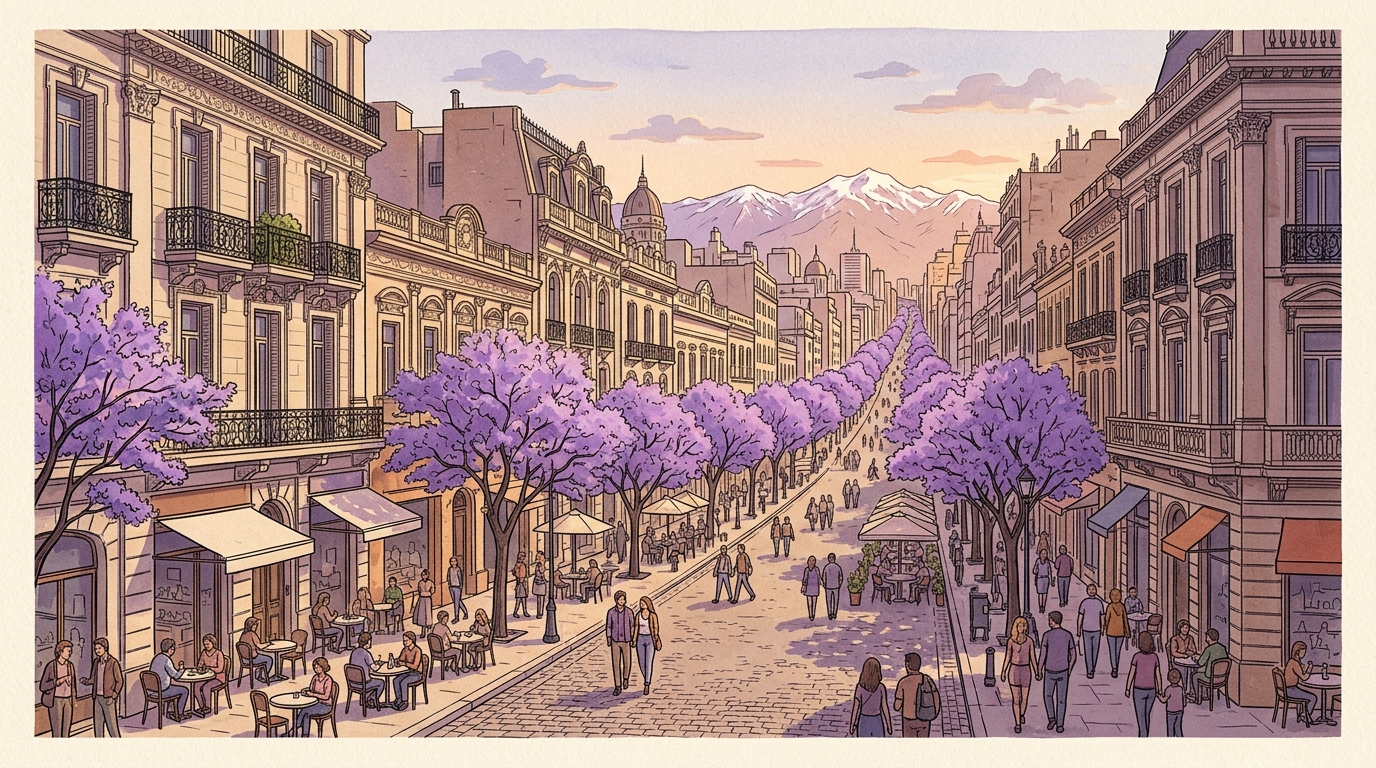
A factual overview of entry rules, bank card acceptance, residency categories under Migration Law 25.871, the May 2025 reform, and the 2-year path to permanent residence and citizenship in Argentina for Russian citizens — based on the Argentina country profile and the entry guide for a Russian passport.
90-Day Visa-Free Entry and Customs Rules
Under the bilateral agreement signed on 11.03.2009 (in force since June 2009), Russian citizens holding ordinary international passports enter Argentina visa-free.
- Length of stay: up to 90 days within each 180-day period, counted from first entry. Stays exceeding 90 days or involving employment/commercial activity require residency under Migration Law 25.871.
- Passport: a valid international passport (no minimum extra validity beyond the trip is specified; diplomatic and service passports are excluded from the waiver).
- Customs limits: duty-free import of up to 200 cigarettes (or 25 cigars), 2 liters of alcohol, 5 kg of food, and gifts up to 300 USD; cash export is capped at 10,000 USD per adult and 5,000 USD per minor.
- Apostille and pets: Argentina is a party to Hague Apostille Convention No. 41. Under
SENASArules (MERCOSUR/GMC Resolution No. 17/2015), importing dogs and cats requires an ISO microchip, rabies vaccination 21+ days prior, and a veterinary certificate issued within 10 days; no quarantine or antibody titer test is required.
Bank Cards, Exchange Rates and 21% VAT Refund
The national currency is the Argentine peso (ARS). In April 2025, most currency controls (cepo) were lifted and the peso moved to a managed float; by mid-2026, official, financial (MEP), and street exchange rates sit within roughly 2–3% of each other.
- Russian cards: Russian Mir, Visa and Mastercard cards do not work. Russian UnionPay cards (ATB, Rosselkhozbank — including Huawei Pay for RSHB) work with limitations: cash withdrawals at
Banco SantanderATMs and retail payments on selectedTerminal NuevoPOS terminals (the cashier may need to select the device manually). - Foreign cards and VAT refund: non-Argentine Visa and Mastercard cards are accepted at hotels, restaurants, shops and supermarkets, settling at the financial MEP rate. Paying for lodging with a foreign card (or foreign bank transfer) is the only way to receive the 21% VAT refund on accommodation (including breakfast when included in the rate); cash payments do not qualify. Cash pesos are still needed for street taxis, markets, tips and small vendors.
Residency Categories: Digital Nomad, Rentista and Employment
Migration Law 25.871 divides admission into three tiers that determine your rights and PR eligibility (see all grounds in the Argentina visas guide):
- Transitory residence (Art. 24) — up to 1 year, does not grant a DNI (national ID card).
- Temporary residence (Art. 23) — up to 3 years, grants a temporary DNI and the right to work (Art. 51).
- Permanent residence (Art. 22) — indefinite, grants a permanent DNI.
In-country applications (radicación) are filed online via RaDEX (except asylum/refugee, religious and humanitarian categories, which must file in person). DNM does not publish processing timelines.
Fee structure: under Decree 584/2024, fees are denominated in UMSM units (1 UMSM = 1,000 ARS). For non-MERCOSUR nationals (including Russians), temporary or permanent residency (Art. 22–23) and renewals cost 100 UMSM; transitory residence (Art. 24) costs 32 UMSM (Art. 24(h) renewals, including digital nomads, cost 40 UMSM); consular filings abroad are billed at 600 consular units. (MERCOSUR nationals pay half: 50 / 16 / 20 UMSM and 300 units.)
| Ground | Law Article | Initial Term | Grants DNI | Counts to PR | Key Requirements |
|---|---|---|---|---|---|
Digital Nomad (nomada-digital) | Art. 24(h) | Up to 6 mos. (renewable) | No | Not listed | Remote work abroad; 32 UMSM fee (40 UMSM renewal) |
Rentista (rentista) | Art. 23(b) | 1 year (renewable) | Yes | Yes | Passive income from assets (real estate, financial instruments, shares) ≥ 5 minimum wages (SMVM) routed via a central-bank-authorized institution |
Pensioner (pensionado) | Art. 23(c) | 1 year (renewable) | Yes | Yes | Verified regular pension income |
Migrant Worker (trabajador-migrante) | Art. 23(a) | 1 year (renewable) | Yes | Yes | Employment contract with an employer registered in RENURE |
Student (estudiante) | Art. 23(j) | 1 year (renewable) | Yes | Yes | Enrollment at an officially recognized educational institution |
Family Reunification (reunificacion-familiar) | Art. 23(ñ) | Up to 3 years (renewable) | Yes | Yes | Spouse, registered partner (unión convivencial), minor children under 18, parents |
Tourists can also apply for a special transitory work authorization (Art. 24(h), Disposition 1824/2013, 100 UMSM fee — the only fee identical for MERCOSUR and non-MERCOSUR citizens), though it does not grant a DNI or extend the entry stamp.
2025 Reform, Permanent Residence and Citizenship
- Permanent Residence (Art. 22): the database records 2 years of temporary residency as the typical threshold (
prYears: 2). Decree DNU 366/2025 of 29 May 2025 amended Art. 22 to require proof of sufficient means of subsistence and a clean criminal record when applying for PR. Temporary residents may be absent up to 6 months (Art. 62(e)); permanent residents up to 1 year. - Citizenship (`citizenshipYears: 2`): naturalization is processed by federal courts under Law 346 after 2 years of continuous legal residence with Spanish language proficiency. DNU 366/2025 tightened the continuity requirement and mandated proving occupation/source of funds via RaDEX. Dual citizenship is permitted.
- Jus soli: a child born in Argentina (except children of foreign diplomats) automatically acquires Argentine citizenship, enabling family reunification for parents.
Climate, Cities and Living Costs
Seasons are inverted relative to the Northern Hemisphere: around Buenos Aires, summer (December–February) averages 23.2 °C to 24.9 °C, and winter (June–August) 7.8 °C to 10.3 °C (Open-Meteo). Heavy rain flooding is the main natural hazard in Buenos Aires and La Plata, Mendoza faces high seismic risk, and Rosario has elevated drug-related violence (nationally, the homicide rate is 3.9 per 100,000 per UNODC 2024, while property theft is the main everyday concern).
National average costs (livingcost.org, 2026): 1-bedroom rent — 393.01 USD/month, 3-bedroom — 820.04 USD/month, utilities — 99.71 USD/month, internet — 22.83 USD/month, transit pass — 29.62 USD/month (single ticket 0.88 USD), fuel — 1.08 USD/L, and grocery basket — 28.05 USD.
Monthly rent and utilities across 5 cities (in EUR):
- Buenos Aires (metro 16.4M, IT hub): 1-bedroom — 513 EUR, 3-bedroom — 940 EUR, utilities — 121 EUR.
- Córdoba (2.16M, second IT hub): 1-bedroom — 326 EUR, 3-bedroom — 575 EUR, utilities — 81 EUR.
- Mendoza (1.03M, wine center): 1-bedroom — 317 EUR, 3-bedroom — 576 EUR, utilities — 100 EUR.
- La Plata (930k, ~50 km from capital): 1-bedroom — 277 EUR, 3-bedroom — 495 EUR, utilities — 39 EUR.
- Rosario (1.75M, Paraná port): 1-bedroom — 209 EUR, 3-bedroom — 382 EUR, utilities — 62 EUR.
Average internet speeds (Ookla Speedtest Global Index, 2026) are 119.58 Mbps fixed and 67.54 Mbps mobile.
Full city, climate and healthcare metrics are on the Argentina country page, and you can compare Argentina with Brazil or Spain in the country comparison tool.
Countries mentioned in the guide
Primary sources
- https://www.kdmid.ru/docs/argentina/information-about-the-country/
- https://www.argentina.gob.ar/interior/migraciones
- https://www.argentina.gob.ar/interior/migraciones/residencias
- https://www.argentina.gob.ar/cuadro-tasas-migratorias
- https://www.argentina.gob.ar/servicio/obtener-una-residencia-transitoria-como-nomada-digital
- https://www.argentina.gob.ar/servicio/obtener-una-residencia-temporaria-como-rentista
- https://www.argentina.gob.ar/servicio/obtener-una-residencia-temporaria-como-trabajador-migrante
- https://www.argentina.gob.ar/servicio/radicaciones-residencia-permanente
- https://www.hcch.net/en/instruments/conventions/status-table/?cid=41
Telegram channel
New guides on travel, entry rules, bank cards, and residency — concise and backed by primary sources.
Subscribe: @relomap_onlineThis material is for informational purposes only and is not legal advice. Verify entry and residency terms on official agency websites.